I'm happy to announce that I submitted a version of my final paper to the Journal of Games Criticism.
Wohoo!

Showing posts with label videogames. Show all posts
Showing posts with label videogames. Show all posts
Friday, April 18, 2014

Thursday, March 20, 2014
Annotated Bibliography for Reclaiming Awe
Working Thesis (which will surely undergo drastic revision): While the digital age
affords us seemingly infinite opportunities, with those opportunities comes the danger of
destroying mankind's most fundamental and universal quality, his capacity to
experience and create awe.
Realistically, you should probably just skip to the end and read my end commentary, because I'm tweaking my emphasis a bit, and that's the part where I'd be most interested in hearing your feedback. Thanks!
Adorno, Theodor W and Max Horkheimer. "The Culture Industry: Enlightenment as Mass Deception." Dialectic of Enlightenment. Trans. John Cummings. New York: Herder & Herder, 1972. 120-167. Print.
Realistically, you should probably just skip to the end and read my end commentary, because I'm tweaking my emphasis a bit, and that's the part where I'd be most interested in hearing your feedback. Thanks!
ANNOTATED BIBLIOGRAPHY
Adorno, Theodor W and Max Horkheimer. "The Culture Industry: Enlightenment as Mass Deception." Dialectic of Enlightenment. Trans. John Cummings. New York: Herder & Herder, 1972. 120-167. Print.
Adorno and Horkheimer propose that modern media encourages passive consumption over true creativity and that in their aspirations toward popularity and industrial utility, they have fallen into a state of artistic or aesthetic impoverishment. This ties into my focus on digital creativity as a means of overcoming the impoverishment and rising from passive consumption to a state of "flourishing" productivity.
Arnold, Matthew. “The Study of Poetry.” 1880. Poetry Foundation. 13 Oct. 2009. Web. 19 Mar. 2014.
In this essay, Arnold proposes that the measure of a work’s poetic or artistic greatness (and I would argue, it’s potential to inspire awe) is based on a combination of personal and historical perspectives. Great works, then, partake of the same spirit as landmark works that have come before--touchstones, as he calls them. This in some sense helps to overcome the sense of subjectiveness that many of us have been struggling with in defining awe.
Tuesday, February 18, 2014
More Emotions from Video Games
+Paul Bills posted recently about video games' potential to evoke emotional response from players, and this was something that I wanted to touch upon a little bit. I've played video games almost all of my life; my family got a SuperNintendo when I was like three, but even before that, my dad had an old Commodore computer with such thrilling adventures as pixel Olympics or, later, Frogger. Now, we have stunning, million-dollar productions with complex themes and characters, stunning scenery, moving soundtracks, and design teams in the hundreds and thousands. The point I'm trying to get at, though, is that games have come a long way in the past twenty or so years. They still have "a lot of growing up to do," as Grant Tavinor puts it in The Art of Video Games, but they are coming into their maturity and are becoming a powerful tool for influencing the human psyche and emotional state.
Paul mentioned a number of emotions, and I wanted to build on his list in contributing what I feel to be paramount pieces in the history of video games.
1. Longing - Final Fantasy

First off, I'll admit that I've played only five or six of the games in the Final Fantasy series (there have been, as I recall, something like 15 *Final* Fantasies to date), but they have nonetheless had a profound impact on me and on my development as a gamer, a thinker, and a creator. In my mind, these games are the most emotionally complex and evocative games on the market, conveying a diversity of profound messages about humanity and the world. For me, though, the most powerful of emotions in the series is that of longing. I don't know that I can pinpoint exactly what it is that so draws the player into the Final Fantasy realm--a rich and immersive world, a profound sense of connection to the divine, a strong ideal of personal agency and potential to change the world, or just sheer awesomeness in fighting monsters and calling on arcane magics--but the longing for that world, for its vitality, is very real. The series has been the subject of an enormous volume of fan fiction, and deviantArt is plastered with thousands upon thousands of examples of art inspired by the fantastical and beautiful world of Final Fantasy. I honestly feel like Final Fantasy is responsible for the aesthetic and thematic qualities of the JRPG genre as a whole and has served as a model for most major modern story games.
Paul mentioned a number of emotions, and I wanted to build on his list in contributing what I feel to be paramount pieces in the history of video games.
1. Longing - Final Fantasy

First off, I'll admit that I've played only five or six of the games in the Final Fantasy series (there have been, as I recall, something like 15 *Final* Fantasies to date), but they have nonetheless had a profound impact on me and on my development as a gamer, a thinker, and a creator. In my mind, these games are the most emotionally complex and evocative games on the market, conveying a diversity of profound messages about humanity and the world. For me, though, the most powerful of emotions in the series is that of longing. I don't know that I can pinpoint exactly what it is that so draws the player into the Final Fantasy realm--a rich and immersive world, a profound sense of connection to the divine, a strong ideal of personal agency and potential to change the world, or just sheer awesomeness in fighting monsters and calling on arcane magics--but the longing for that world, for its vitality, is very real. The series has been the subject of an enormous volume of fan fiction, and deviantArt is plastered with thousands upon thousands of examples of art inspired by the fantastical and beautiful world of Final Fantasy. I honestly feel like Final Fantasy is responsible for the aesthetic and thematic qualities of the JRPG genre as a whole and has served as a model for most major modern story games.
Friday, January 24, 2014
How Quickly We Come So Far
 |
| Me at the RMMLA Convention in October |
That means that within the space of just 12 months, I went from being unsure about what I wanted to do exactly with my life but leaning toward literature professor or maybe ditching English altogether for sociology, to planning my entire career path around a subject I was almost completely unversed in at the time.
The decision alone might be somewhat impressive, but what's really blown me away is how quickly I was able to dive into that decision. Not only did I say I would do something totally different than I had ever planned before, I've written over 20 in-depth blog posts on videogames, presented at a professional conference on the subject, been featured in one of the leading blogs of the field, and published on an online journal. I don't say these things to brag about my accomplishments, but to wonder at how quickly I turned so completely around and dove so deep into this field.
Considering how quickly it all happened, I almost panicked for a second. I've now applied to two different graduate programs to carry on this path I've started down, and considering how quickly I changed from one thing to another in just a year made me wonder if I'd totally change my mind again in another year's time. For a second, I wondered if I even liked videogames that much, to dedicate potentially my entire professional life to them. It was pretty easy to reassure myself that I did, but it was still a wondrous thought.
Where will I be a year from now? If the past year has been any indication, I really have absolutely no idea.
Friday, January 17, 2014
Awesome Videogames: a Follow-Up to My Class Presentation
Okay, my class presentation showing off The Last of Us, Bioshock Infinite, and Brothers: A Tale of Two Sons just finished. I'm counting the presentation itself and comments from the rest of the class as enough social proof to write a blog post about these moments that have inspired awe in me and want to take this opportunity to follow-up and perhaps better explain some things that weren't totally clear in the presentation itself.
To be honest, I have no idea how much awe was actually felt by members of the class as I showed them these three videogame sequences. I noticed +Carly Brown say, "That's so cool," when we solved the swimming problem in Brothers, and +Andrew Perazzo enthusiastically commented on how good the graphics looked in Bioshock. I also heard a few murmurs generally as the Salt Lake Temple first came into view in the sequence from The Last of Us. I feel like the first presentation could have been a lot more powerful if I hadn't screwed up the saved game like I did, and I sincerely apologize to everyone for the weird starting foot that put us on for the whole presentation. I'd like to take a moment to better examine each sequence and why it specifically inspires awe.
The Last of Us

After screwing up the game itself and resulting to YouTube, I stumbled through showing the instantly iconic giraffe sequence from The Last of Us. I mentioned in class the masterful subtly of this sequence as well the poignant symbolism of the giraffe walking out of the shot after Ellie takes full responsibility and the (literal) lead in going forward to find a cure and we realize Ellie childhood innocence is now totally gone and she's become an adult before her time (she's only 14). I also emphasized how breathtaking the sequence is against the backdrop of hours and hours of violence that come before it.
To be honest, I have no idea how much awe was actually felt by members of the class as I showed them these three videogame sequences. I noticed +Carly Brown say, "That's so cool," when we solved the swimming problem in Brothers, and +Andrew Perazzo enthusiastically commented on how good the graphics looked in Bioshock. I also heard a few murmurs generally as the Salt Lake Temple first came into view in the sequence from The Last of Us. I feel like the first presentation could have been a lot more powerful if I hadn't screwed up the saved game like I did, and I sincerely apologize to everyone for the weird starting foot that put us on for the whole presentation. I'd like to take a moment to better examine each sequence and why it specifically inspires awe.
The Last of Us
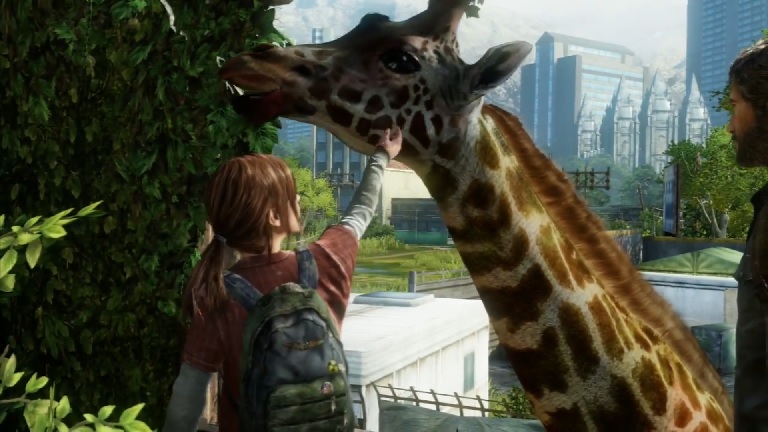
After screwing up the game itself and resulting to YouTube, I stumbled through showing the instantly iconic giraffe sequence from The Last of Us. I mentioned in class the masterful subtly of this sequence as well the poignant symbolism of the giraffe walking out of the shot after Ellie takes full responsibility and the (literal) lead in going forward to find a cure and we realize Ellie childhood innocence is now totally gone and she's become an adult before her time (she's only 14). I also emphasized how breathtaking the sequence is against the backdrop of hours and hours of violence that come before it.
Subscribe to:
Posts (Atom)