
Showing posts with label awe. Show all posts
Showing posts with label awe. Show all posts
Saturday, April 19, 2014

Friday, April 18, 2014
My Journey Through Awe
When I started this class, I had no idea what it was going to entail. Throughout the semester, I feel like I've gone on this journey that has helped me truly understand what awe is.
The first thing that I did that helped me understand what brings me awe, was the list of 10 books that bring me awe. You can find it here. From there, I had to move beyond what brings me awe, into how awe can function and work. So I chose to write a post about The Yellow Wallpaper. A short story that has caused me to feel many different things over the course of my scholarly life, it finally helped me understand one of the many different ways that awe can work.
From here, I'm not really sure what happened. But something inspired me to start thinking about the awe of dance, and how that functions in literature and digital media. So I started to baby my idea, and grow it in different ways. Then I did my picture story thing. And that really helped me clarify my ideas, and figure out what I really wanted to talk about for my final project.
A few days later we did the digital media awe list, and that was really cool for me, to be able to explore a slightly different idea but still find ways in which it related to dance as well. One of my favorite awe inspiring example of digital media that relates to dance is still Thought of You, which is at the end of my list.
After this, my journey becomes pretty focused on my paper and prototype. I developed my creative side of my research first, and as a result, I had my prototype up before I had even started my paper, but my prototype helped me refine my ideas further, so it all worked out. And then I started researching for my paper. My list of sources came first, followed by what I had so far (but still nowhere near finished). My final draft is something that I'm quite pleased with (although it still wasn't finished), and since then, my paper has gotten even better.
My journey through awe has been unique and interesting. I have learned more about dance than I already knew, and I think that is what surprised me more than anything. It's been a wonderful journey. And at the end of my journey, I came out with a paper that I'm proud of.
The first thing that I did that helped me understand what brings me awe, was the list of 10 books that bring me awe. You can find it here. From there, I had to move beyond what brings me awe, into how awe can function and work. So I chose to write a post about The Yellow Wallpaper. A short story that has caused me to feel many different things over the course of my scholarly life, it finally helped me understand one of the many different ways that awe can work.
From here, I'm not really sure what happened. But something inspired me to start thinking about the awe of dance, and how that functions in literature and digital media. So I started to baby my idea, and grow it in different ways. Then I did my picture story thing. And that really helped me clarify my ideas, and figure out what I really wanted to talk about for my final project.
A few days later we did the digital media awe list, and that was really cool for me, to be able to explore a slightly different idea but still find ways in which it related to dance as well. One of my favorite awe inspiring example of digital media that relates to dance is still Thought of You, which is at the end of my list.
After this, my journey becomes pretty focused on my paper and prototype. I developed my creative side of my research first, and as a result, I had my prototype up before I had even started my paper, but my prototype helped me refine my ideas further, so it all worked out. And then I started researching for my paper. My list of sources came first, followed by what I had so far (but still nowhere near finished). My final draft is something that I'm quite pleased with (although it still wasn't finished), and since then, my paper has gotten even better.
My journey through awe has been unique and interesting. I have learned more about dance than I already knew, and I think that is what surprised me more than anything. It's been a wonderful journey. And at the end of my journey, I came out with a paper that I'm proud of.
Tuesday, April 15, 2014
Resolution: The World Makes Sense Again
This semester has been a really interesting one in terms of the progression of my research topic and my feelings toward it. I can honestly say that I've never had a semester that was so frustrating , but I've been able to push through and have come to a synthesis moment, to borrow the term from Hegel.
I think one of my problems going into the paper for this class was that I came with so many topics that I wanted to address. Awe was and still is, in my mind, an interdisciplinary notion, and I think that biology, literary criticism, philosophy, psychology, and critical art theory all have important things to say about it. As I studied it more, though, I began to realize that I wasn't the only one having problems figuring out awe. The texts contradicted themselves, everyone used different words for the same things, and the works that seemed to be the most accurate in trying to define awe seemed to be the most abstract and vague and well. You might say that for about three months, I was pretty frustrated and had no idea what I was doing.
 |
| CC 2.0 Generic, Wikimedia Commons |
Monday, April 14, 2014
Final Draft: Awe Evolving
Well, after a long journey involving changing my entire premise no fewer than three times, my final paper is at last done. I'm not entirely sure that I understand awe a whole lot better than I did when I began, but I feel a lot more a peace with the place of awe in the digital world, and that's really valuable to me. I'll be posting the story of my paper tomorrow, so stay tuned, but until then, here's the final draft.
Awe Evolving: Transforming Notions of Awe in the Digital Age
Awe Evolving: Transforming Notions of Awe in the Digital Age
Monday, April 7, 2014
The Evolution of Awe
Well, I'm at just over 4,800 words so far for my paper. I've left some wiggle room, as my publication venues allow for submissions of a maximum of 5,000 words. In any case, I'm finally to a premise that I can get behind, and while it doesn't have the same direction or social implications as my previous topics, I think it's a good direction for my research. Here's my thesis, and the link to the paper itself is below that.
Rough draft of the paper
THESIS: We are experiencing a transformation of the way in which we experience awe, and while we necessarily move toward an understanding of awe that is not only more abstract in some ways but in other regards less real, our capacity to experience awe remains the same as we actively implement modern technologies in creating awe. As society evolves to be able to meditate upon increasingly complex social, artistic, and philosophical values and issues, so also must our modes of expression and conveyance necessarily take on abstraction as a way of accommodating the ever-complicating human narrative.
Rough draft of the paper
Wednesday, April 2, 2014
Social Proof for Reclaiming Awe
Over the past couple of days, I've been attempting to reach out to communities and specialists that might be able to offer some insight on awe in the world of digital art.
I started with a few communities of digital artists on Google+, and I posted something akin to the following in each:
I'm currently researching the concept of awe in various forms of digital art. Do you as digital creators feel that digitally native works of art differ from more traditional forms in their ability to produce awe in the viewer? Certainly, the digital medium facilitates a broader range of awe-inspiring subject matter, but does it provide for the same quality of awe as would, for example, looking at a painting or watching a play over seeing an image online or watching a 3D reproduction of the same play?I haven't heard back from anyone on my posts as of yet, but I hope that I'll get some responses over the next few days. I think I'll also post something to the Thinkers community, as I've have good success getting responses from them in the past.
I'm not sure that there is a right answer, but I'd love to hear your thoughts on the matter in any case! Thanks!
I also wrote to Jeffrey Davis, a writer for Psychology Today who maintains a blog called "Tracking Wonder." The letter I sent is included below:
Wednesday, March 26, 2014
What I Have So Far
The Language of Dance
“Some people believe they have an intuitive understanding
of dance. Lay people, social scientists, and even dancers often use the term dance with the vague and uncritical
connotations of ordinary speech” (Hanna 17). After having danced for almost
twenty years, I have an intuitive understanding of dance, but it’s nearly
impossible for me to articulate that understanding into a definition. Because
of this difficulty, most people are unaware of the complexity of dance. What
most don’t understand about dance is that it is a language that is just as
complex as French or German. It has different levels and aspects to it; they’re
just different than those you would find in a spoken language. There are many
different parts surrounding the art form of dance as a whole. However, to
understand how dance functions as a language and the powerful appeal that it
holds, it is important to first have an understanding of how dance is defined.
“So varied are the forms of dance…that it is difficult to offer a single
definition or description that encompasses all forms” (Kraus 3). However, after extensive analysis of the
different forms and motivations behind these forms of dance, Kraus comes to
this definition of dance:
“Dance is an art performed by individuals or groups of human
beings, existing in time and space, in which the human body is the instrument
and movement is the medium. The movement is stylized, and the entire dance work
is characterized by form and structure. Dance is commonly performed to musical
or other rhythmic accompaniment, and has as a primary purpose the expression of
inner feelings and emotions, although it is often performed for social, ritual,
entertainment, or other purposes” (Kraus 13).
Dance is a difficult thing
to define, if only because it’s such a fluid and complicated form of expression.
The definition that Kraus gives is the most accurate that I have come across in
my research, albeit a bit more clinical than some. However, my point doesn’t
lie in the definition; it lies in the truth that whether or not we, as
individuals, are able to express our emotions through the movement of our body,
“there is an innate, creative impulse toward expressive movement in each of us
human beings” (Taylor 5). It is because of this creative impulse that resides
in each of us as human beings, that the language of dance is able to instill
awe in audience and dancers alike.
Mary Wigman states that “The dance is a living language
which speaks of man—an artistic message soaring above the ground of reality in
order to speak, on a higher level, in images and allegories of man’s innermost
emotions and need for communication” (10). Certainly a large part of the
language of the dance is the movement used. Movement is what gives meaning and
significance to the gestures of dance. “When the emotion of the dancing man
frees the impulse to make visible his yet invisible images, then it is through
bodily movement that these images manifest themselves in their first stages”
(Wigman 10). The movements that the dancers employ to convey meaning is
deepened by the emotion and understanding that the dancer has of their own
body. In order for the movement of the dancer to be effective in conveying
meaning, the dancer must be able to understand what his or her body can do. While
body movement alone is not what makes dance a complete language, “…it is the
elemental and incontestable basis without which there would be no dance”
(Wigman 10). In my research on the languages of dance, I found that expert Judith
Lynn Hanna adds to the evidence that movement is essential to the art form of dance
by saying that “Meaning in dance is thus found internally, in the stylistic and
structural manipulation of the elements of space, rhythm, and dynamics, and the
human body’s physical control. In the embodied meaning of dance, one aspect of dance
points to another rather than to what exists beyond the dance performance” (Hanna
24).
Tuesday, March 18, 2014
First 5 Pages of "The Awesome Ghost in the Machine of Videogame Aesthetics"
So, my creative prototype is already up, but my work on my paper was falling behind, so here's a link to my work in progress of a paper (the final paragraph is something I cut from the intro but didn't want to totally get rid of):
http://1drv.ms/1dcdxyy
Let me know what you think!
http://1drv.ms/1dcdxyy
Let me know what you think!
Sunday, March 16, 2014
Outline of Awesomeness...
I have to admit, as did
Tara, that I still feel hopelessly lost in trying to define awe in
any meaningful way. I feel like I have my own idea of what awe is,
but I'm fairly certain at this point that it is entirely different
from how others view awe, each of our own experiences having been
shaped by our own experiences with awe. I think that is to say that I
am experiencing an existentialist crisis
rooted in German Romantic notions of subjectivity. There's a mouthful
for you. So, in short, I feel less and less confident in my paper
topic as I research more and more, and that's not the most
comfortable position.
In
any case, I think that my final paper will have a substantial portion
attempting to address that which has been said before in terms of
defining awe. I feel like just about every major literary critic has
had something to say of awe, whether they called it the sublime,
geist, the aura, or
something else, and I want to focus on each of those notions in
building a foundation for the notion of awe that I present in my
paper.
Another
complication is that my paper topic, at least in part, is very
negative, and I'm looking for ways to expand it in a direction that
is more positive without it coming off as an infantile call to
create. That being said...
Outline of Awesomeness...
Please feel free to add information or insert questions or comments or whatever. GoogleDocs has a new "track changes" add-on, so I'd love to see how it works (and I have a back-up saved just in case someone goes crazy on my outline).
 |
I'm excited about my project, but it's definitely taking a lot
of time, and I'm wondering if I should simplify it rather than
botching the wonder. I think a lot will depend on time.
|
And finally, in terms of what's next, I think the biggest part is just getting my paper and project nailed dow
n a bit more. I feel like I'm putting them both off a little bit, as I'm still not really sure about my overall premise or my definition of awe, but I think some of that will work itself out as I put together a more complete draft of my paper and finish up my project. I may need to simplify my project a bit, as it's taken a ton of time and still isn't really in a presentable form. Anyway, I'd love to hear your feedback!
Two Ideas on Awe in Videogames: Paper Treatments
So, ever since Dr. Burton met together and came up with my creative project idea, I've kind of been lost on my paper topic, but I think I've come up with something that will work and that I can get published. I just need to pick which of two angles to take.
FIRST ANGLE
Basically, I want to write a theoretically grounded, detailed look at the specific ways game designers can elicit awe in players. Rather than just listing the ways games can inspire awe, I want to get deep into the techniques used and the psychology employed. I'm inspired by Greg's more theoretically-grounded posts and I want to follow that example more. This paper will read as much like design advice as it will a scholarly paper. I plan on including analysis of specific techniques employed by different games and how those techniques function. Here's an outline of how I expect it to go:
This other idea is actually a paper idea I had last semester while anticipating this class and had gotten really excited about, then completely forgotten until I sat down to write this outline post. I don't know which idea I should go with, though, so I'm giving both of these and asking you all to help me pick.
This paper is specifically on the connection between awe caused by advancing videogame technology and to what extent the actual content of the game is meant to inspire awe. For instance, The Elder Scrolls V: Skyrim was perhaps the most technologically advanced game ever made when it came out, and at the same time, it had an epic storyline involving fighting dragons, saving cities from death, and travelling all around the world. My argument is that so many videogames stories use tropes and conventions of awe because they are also trying to inspire awe through showing off their technology. This is an alternative explanation to why games are so focused on fantasy and violence and escapism--because those things inspire awe, and awe has been an implicit fundamental goal of the medium ever since its inception.
Possible Venues
All of the venues I scoped out for my previous possible venues post would be appropriate for either of these papers. If I did the first idea, I would add Gamasutra, a site specifically geared at game designers. If I do the first idea I would likely send a shortened version there. However, I think the venue I will most focus on as I write is Journal of Games Criticism. It has the level of sophistication I'm aiming for as well as the subject matter, and they're pretty new so my likelihood of publication is higher.
Next Steps
I now just need to figure out which idea to pursue. If I do the first idea I'll have to do a lot of research into theoretical backgrounds of things. For the second idea I'll also need to research, but I have a lot of resources readily available on a lot of those things, especially vidoegame history.
FIRST ANGLE
Basically, I want to write a theoretically grounded, detailed look at the specific ways game designers can elicit awe in players. Rather than just listing the ways games can inspire awe, I want to get deep into the techniques used and the psychology employed. I'm inspired by Greg's more theoretically-grounded posts and I want to follow that example more. This paper will read as much like design advice as it will a scholarly paper. I plan on including analysis of specific techniques employed by different games and how those techniques function. Here's an outline of how I expect it to go:
- Intro
- Art and awe-discussion on how awe is associated with great art and expression
- What is awe? How is it elicited? How do games elicit awe?
- Definitions of awe
- Theoretical definitions of awe
- Reasons we've developed awe as an emotion
- Mechanics of awe
- Theoretical strategies for developing awe in an audience
- Examples from other arts that are often cited as great at eliciting awe
- Videogames and awe
- Re-examination of theories of awe in light of videogames
- What strengths does the videogame medium give designers specifically in creating awe in the player?
- What weaknesses does the medium present, and how can they be compensated for?
- Examples
- Wide range of examples of innovative games that have elicited awe in their respective moments, and how they did it--could include work from emotions post here
- Technology's role
- How dependent is the medium on its technology to create awe?
- Examples of games that have caused awe with technology
- Games that have inspired awe despite technological limitations
- Story
- Strengths and weaknesses of telling stories in videogames
- Strategies for successfully producing awe in videogame narratives, with examples
- Reasons to cultivate awe in and through videogames
- Awe, when done right, is both intellectual and emotional, and that's exactly the spot games need to hit to continue expanding their audience and importance
- Conclusions
- Summary of given strategies and arguments
- Final statement of importance of continuing progress of the medium to the wider world of art and culture.
This other idea is actually a paper idea I had last semester while anticipating this class and had gotten really excited about, then completely forgotten until I sat down to write this outline post. I don't know which idea I should go with, though, so I'm giving both of these and asking you all to help me pick.
This paper is specifically on the connection between awe caused by advancing videogame technology and to what extent the actual content of the game is meant to inspire awe. For instance, The Elder Scrolls V: Skyrim was perhaps the most technologically advanced game ever made when it came out, and at the same time, it had an epic storyline involving fighting dragons, saving cities from death, and travelling all around the world. My argument is that so many videogames stories use tropes and conventions of awe because they are also trying to inspire awe through showing off their technology. This is an alternative explanation to why games are so focused on fantasy and violence and escapism--because those things inspire awe, and awe has been an implicit fundamental goal of the medium ever since its inception.
- Intro
- Outline argument: videogame content is determined in large part by the implicit fundamental goal of videogames to inspire awe through innovative technologies.
- Brief history of videogames
- Give a background on goals and drives in the early videogame industry to show how that created a certain mindset about the purposes and potentials of the medium that still influence designers today
- Spacewar! and early games--meant to justify computers
- Pong and the rise of arcades--meant to draw players back again and again through both mechanics and novelty
- This is why graphics mattered, the novelty enhanced the fantasy, which drew revenue
- MUDs, the text adventure, and online gaming--first time story was emphasized over technology (no graphics), but introduced idea of online muliplayer gaming, promising awe scales of participation (good for both revenue and player engagement)
- Modern games have inherited this legacy and continue to push technological boundaries to increase player engagement
- Each try to couch that technology within the proper epic storyline to merge form and content into an irresistible "mind-blowing" experience that gamers can't avoid.
- Examples (Skyrim, Shadow of the Colossus, GTAV, etc.)
- MMOs--blurring lines of fantasy and reality to further inspire awe on both technological and narratological levels
- Examples (World of Warcraft, Halo community challenges, Destiny, DayZ)
- The converse is also true
- Rise of "nostalgia" and "retro" game design techniques has actually inspired the downgrading of the storylines as well
- Examples (Papers, Please, Rogue Legacy, Braid)
- This is why "art" games often de-emphasize graphics, because it lets them pull back to realistic and grounded "human" stories that the traditional art crowd has always loved
- Therefore, the reason game narratives have so often taken the shapes they have is not simply teenage power fantasy, but the tropes of awe that have always been present and a tacit requirement of the medium to justify itself and the technology it's built upon
- Games beginning to recognize this and break trend to serve new goals
- The Last of Us, grounded human story, mind-blowing tech, goal of "art" on every level
- Gone Home similar track (tech not as impressive, but meant to appear realistic)
- Prediction: as games become less dependent on constantly improving technologies (especially graphics), the medium will break further from the constant power fantasy as the medium will become less concerned with justifying and showing off its underlying technology.
- Comparisons to film--follows same pattern of epic technology, epic story, had similar pattern of first films having to justify and explain film itself, then were set free to exlore whatever they wanted, now you can make a film about anything
- Conclusion
- There's more to the content of games than just power fantasies and ruining our children. The history has dictated a lot of patterns, but the medium will break free from those patterns, and in many ways has already begun to do so.
Possible Venues
All of the venues I scoped out for my previous possible venues post would be appropriate for either of these papers. If I did the first idea, I would add Gamasutra, a site specifically geared at game designers. If I do the first idea I would likely send a shortened version there. However, I think the venue I will most focus on as I write is Journal of Games Criticism. It has the level of sophistication I'm aiming for as well as the subject matter, and they're pretty new so my likelihood of publication is higher.
Next Steps
I now just need to figure out which idea to pursue. If I do the first idea I'll have to do a lot of research into theoretical backgrounds of things. For the second idea I'll also need to research, but I have a lot of resources readily available on a lot of those things, especially vidoegame history.
Wednesday, March 12, 2014
Project Prototype One
 |
| Creative Commons License 2.0 Road to Neverland by imsad |
My final paper will be examining the psychology of awe and the cycles of it. Why do we turn back to the same sources of awe (like Alice to Wonderland or Peter Pan to Neverland)? Do we get caught in a cycle of experiencing an awe moment, then returning to the mundane (like the people in Dubliners)? I want to incorporate these cycles, and have decided to take one, two, or all of the options below as my final project.
Option 1: Mirrored or Palindrome Poetry
In case you don't remember, a palindrome is a word, phrase, verse, or sentence that reads the same forward or backward. In a mirrored or palindrome poem, the words read the same backwards or forwards like in these two examples. I could try this and incorporate the books I'm going to explore as the subject.
Option 2: Reverse Poetry
Where reading a reverse poem, one direction tells one meaning, then reading it backwards tells another message. Just last week a teenager's reverse poem went viral on twitter. It would be brilliant to tell something about the cycles of awe reading negatively one way, then positively the next. I just have to really practice this style of poem.
Where reading a reverse poem, one direction tells one meaning, then reading it backwards tells another message. Just last week a teenager's reverse poem went viral on twitter. It would be brilliant to tell something about the cycles of awe reading negatively one way, then positively the next. I just have to really practice this style of poem.
Option 3: Circle Poetry
There are a couple different variations of circle poetry. There is visual poetry where I could write poems in circles or circular styles. This book contains one variation of visual circle poetry. It's very simple. This blog section is dedicated to another style, though some of these poems I have a hard time understanding. Another aspect to circular poetry includes repeating first and last lines, or coming back to the same places in the start and finish. I'd like to be able to do that too.
I could put these poems online with specific labels or tags under the creative commons license to give people access to them. Or I could write one of these poems and make a simple YouTube video to cultivate my ideas there too. Any thoughts would be great on how I could get these poems out there. Or if you have any idea of a specific audience to target that would be great too.
There are a couple different variations of circle poetry. There is visual poetry where I could write poems in circles or circular styles. This book contains one variation of visual circle poetry. It's very simple. This blog section is dedicated to another style, though some of these poems I have a hard time understanding. Another aspect to circular poetry includes repeating first and last lines, or coming back to the same places in the start and finish. I'd like to be able to do that too.
I could put these poems online with specific labels or tags under the creative commons license to give people access to them. Or I could write one of these poems and make a simple YouTube video to cultivate my ideas there too. Any thoughts would be great on how I could get these poems out there. Or if you have any idea of a specific audience to target that would be great too.
With Wondering Awe: Project Prototype

I've been thinking a lot about what I'd like to do for the creative component of my final project, and I keep going back to that phrase, "create the wonder." I've been really impressed with a lot of videos that I've come across as I've been researching awe, and the more I think about it, the more I want to create a video to get my ideas across. One of my central ideas is that while the digital--when used purely as a mimetic tool--conveys only a diminished sense of awe, its creative and synthetic potential supersedes that of traditional mediums. Though art or writing or music can draw us in and bring us to a state of wonder, film and other more modern media formats have the potential to combine the best of art, music, writing, etc. in a single, unified, immersive work. The wonder of the digital age, though, is that creation of such works is no longer limited to large production studios, especially with vast bases of open content through Creative Commons licenses. Building on this notion, the focus for my final project will be a video that combines original writing (narration), an original piano score, and Creative Commons video clips in an effort to awaken viewers to a new reverence for traditional sources of awe and instill within them a new determination to utilize modern modes of creation to inspire awe.
I've already begun writing out the script, and I've been recording tidbits of music, trying to figure out a general flow for the piece as a whole. I want it to reach a point of climax that is paralleled in the language, music, and video simultaneously, so I've been trying to figure out how to convey that in each medium. Also, I've been going through Creative Commons videos on Vimeo and downloading ones that have moments that I like.
Monday, March 10, 2014
Deconstructing Dance: My Prototype
Okay, so for my prototype, I've been playing with the idea that knowing more about a subject can help you find more awe in your experience with that subject. Does knowing more about something increase the level of awe? Or does it take away from the spectacle and illusion of the subject?
I've decided to focus my efforts on Ballet, since that's the form of dance that I know the most about, and hopefully my knowledge will allow you to experience more awe when you watch this segment at the end of this prototype.
Just follow the links! (also, most of the webcam videos are truly terrible quality, but you can see my face and hear me, so just know that the quality would be much better on the finished product)
Intro to Prototype
Swan Lake - Only watch to about minute 3:30.
Hands and Arms
Swan Lake (Hands and Arms) - Watch to minute 4 (This is the same clip as the first video)
Legs and Feet
Swan Lake (Legs and Feet) - Watch to minute 4 (This is the same clip as the first video)
Head and Neck
Swan Lake (Head and Neck) - Watch to minute 6ish (Same video, just further along)
Facial Expressions
Swan Lake (Facial Expressions) - Watch to minute 7
Interaction with Partner
Swan Lake (Interaction with Partner) - Watch to end
Conclusion
Swan Lake (Last Viewing) - Watch to end
And that's it! Sorry that you have to follow so many links, but it was the easiest way for me to do things. Let me know what you thought!
I've decided to focus my efforts on Ballet, since that's the form of dance that I know the most about, and hopefully my knowledge will allow you to experience more awe when you watch this segment at the end of this prototype.
Just follow the links! (also, most of the webcam videos are truly terrible quality, but you can see my face and hear me, so just know that the quality would be much better on the finished product)
Intro to Prototype
Swan Lake - Only watch to about minute 3:30.
Hands and Arms
Swan Lake (Hands and Arms) - Watch to minute 4 (This is the same clip as the first video)
Legs and Feet
Swan Lake (Legs and Feet) - Watch to minute 4 (This is the same clip as the first video)
Head and Neck
Swan Lake (Head and Neck) - Watch to minute 6ish (Same video, just further along)
Facial Expressions
Swan Lake (Facial Expressions) - Watch to minute 7
Interaction with Partner
Swan Lake (Interaction with Partner) - Watch to end
Conclusion
Swan Lake (Last Viewing) - Watch to end
And that's it! Sorry that you have to follow so many links, but it was the easiest way for me to do things. Let me know what you thought!
Friday, March 7, 2014
Spreading the Wonder: Possible Publication Venues
1. Buzzfeed. I found this on just about every social network simply by existing. In that Buzzfeed is the subject of some of my more biting criticism, I see it only fitting to make a Buzzfeed Communities post to talk about how un-awe-inspiring Buzzfeed really is.
2. Tracking Wonder. I came across this site while doing some research earlier this semester. Davis is active in posting about wonder and awe (posted about a month ago), so he might be willing to do a collaborative post or let me guest blog if I were to contact him.
3. Communication, Culture, & Critique. I found this through a Google search for cultural critique, which I then refined to search for calls for papers. The journal itself is published by the international communication association, and the topic corresponds rather nicely to the overall emphasis of the journal (i.e. communication and cultural criticism).
4. Journal of Digital Culture and Electronic Scholarship. I found this through a Google search for "digital culture critique call for papers." The journal accepts submissions on a variety of topics related to the arts, humanities, or social sciences. Of especial interest in their list of potential topics were applied psychology and cyber-psychology, both of which relate to my study of the chemistry/physiology of awe.
5. Cyberpsychology. I found this one thanks to a keyword that I found in researching the last one: cyberpsychology. This journal publishes works dedicated to social science in cyberspace, so my study of awe in cyberspace should fit in nicely, especially in light of the more psychological components of my research.
6. International Journal of Humanities and Cultural Studies. I found this through the UPenn listings for calls for papers. The journal has an emphasis on interdisciplinary cultural studies, so I think it would be a good fit for my research.
2. Tracking Wonder. I came across this site while doing some research earlier this semester. Davis is active in posting about wonder and awe (posted about a month ago), so he might be willing to do a collaborative post or let me guest blog if I were to contact him.
3. Communication, Culture, & Critique. I found this through a Google search for cultural critique, which I then refined to search for calls for papers. The journal itself is published by the international communication association, and the topic corresponds rather nicely to the overall emphasis of the journal (i.e. communication and cultural criticism).
4. Journal of Digital Culture and Electronic Scholarship. I found this through a Google search for "digital culture critique call for papers." The journal accepts submissions on a variety of topics related to the arts, humanities, or social sciences. Of especial interest in their list of potential topics were applied psychology and cyber-psychology, both of which relate to my study of the chemistry/physiology of awe.
5. Cyberpsychology. I found this one thanks to a keyword that I found in researching the last one: cyberpsychology. This journal publishes works dedicated to social science in cyberspace, so my study of awe in cyberspace should fit in nicely, especially in light of the more psychological components of my research.
6. International Journal of Humanities and Cultural Studies. I found this through the UPenn listings for calls for papers. The journal has an emphasis on interdisciplinary cultural studies, so I think it would be a good fit for my research.
Wednesday, February 26, 2014
The End of Art and Awe: Hegel in the Digital Age

istic philosophies of Georg Wilhelm Friedrich Hegel.
Hegel is perhaps best known for the eponymous Hegelian dialectic, which suggests that through the recursive struggle and interplay of thesis and antithesis--of action and reaction--mankind has, at various times, been able to arrive a state of synthesis or resolution, wherein he is able to achieve real progress. In his Introduction to The Philosophy of Art, Hegel applies the dialectic to the progression of art, stating essentially that the highest form of art is that in which the sensuous form (the work of art itself) and the spiritual form (the ideas conveyed by the work of art) find harmony or resolution. "[T]he perfection and excellency of art," he writes, "must depend upon the grade of inner harmony and union with which the spiritual idea and the sensuous form interpenetrate" (376). Hegel suggests that in lower forms of art, such as sculpture or architecture, the thesis and antithesis of spiritual and sensuous forms have yet failed to reach an equilibrium. The highest form of art--the end or aim of art in Hegel's view--is in poetry, wherein the art itself is capable of conveying the full import and meaning of the spiritual or philosophical idea. This was not to imply, however, that art had or would come to an end or that poetry represented the final destination of human expression and artistic representation. Rather, poetry was the degree of synthesis to which mankind had climbed up until that point.
Thursday, February 20, 2014
Seeing the World Again: Awe and Renewal
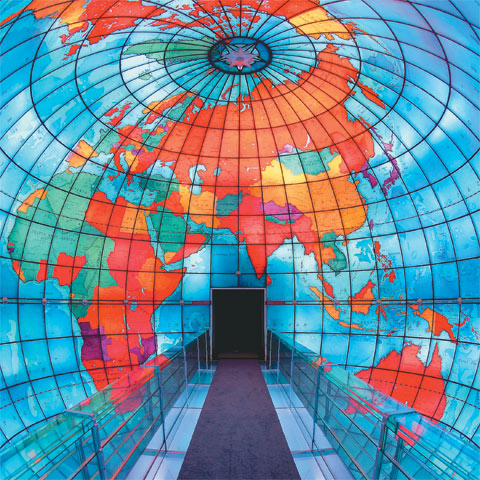 I wanted to write a bit about reversal or renewal of perspective as a source of awe. I've seen this in a number of different literary works, but one of the examples that sticks out most in my mind is the Mapparium scene in Jhumpa Lahiri's short story, "Sexy." The story follows the somewhat rocky relationship of an Indian woman named Miranda and her boyfriend, Dev and Lahiri uses the Mapparium scene as a way to explore perspective, suggesting that things (and at times, relationships) look different from the inside than they do from without. She paints the scene beautifully with a description of Miranda and Dev standing in a vast, globe-shaped room:
[H]e showed her his favorite place in the city, the Mapparium at the Christian Science center, where they stood inside a room made of glowing stained-glass panels, which was shaped like the inside of a globe but looked like the outside of one. In the middle of the room was a transparent bridge, so that it felt like standing in the center of the world. . . The ocean, as blue as a peacock's breast, appeared in two shades, depending on the depth of the water. He showed her the deepest spot on earth, seven miles deep, above the Mariana Islands. They peered over the bridge and saw the Antarctic archipelago at their feet, craned their necks and saw a giant metal star overhead. As Dev spoke, his voice bounced wildly off the glass, sometimes loud, sometimes soft, sometimes eluding Miranda's ear altogether.The scene initially seems full of wonder from the sheer beauty of the description and the reversal of perspective, the characters looking at the world from inside rather than outside and seeing it almost as if with new eyes. Lahiri invites the reader to look at the world from a new perspective, and in creating such awe around a reversal of perspective, she helps the reader to anticipate the later ideological reversal with regard to Miranda's own views of her relationship and what it means to be "sexy."
In her Pichi Kuchi, +Jane Packard noted, "the digital world can enhance/expand/enable enjoyment of its antithesis, the natural world," showing how things like digital webcams allow us to experience the natural world in ways that would have been otherwise inaccessible. As does Lahiri's work, such digital resources invite us to see the world through new eyes and come to a richer and/or renewed perspective on life. Awe transforms the world so that we can be transformed with it.
Tuesday, February 18, 2014
More Emotions from Video Games
+Paul Bills posted recently about video games' potential to evoke emotional response from players, and this was something that I wanted to touch upon a little bit. I've played video games almost all of my life; my family got a SuperNintendo when I was like three, but even before that, my dad had an old Commodore computer with such thrilling adventures as pixel Olympics or, later, Frogger. Now, we have stunning, million-dollar productions with complex themes and characters, stunning scenery, moving soundtracks, and design teams in the hundreds and thousands. The point I'm trying to get at, though, is that games have come a long way in the past twenty or so years. They still have "a lot of growing up to do," as Grant Tavinor puts it in The Art of Video Games, but they are coming into their maturity and are becoming a powerful tool for influencing the human psyche and emotional state.
Paul mentioned a number of emotions, and I wanted to build on his list in contributing what I feel to be paramount pieces in the history of video games.
1. Longing - Final Fantasy

First off, I'll admit that I've played only five or six of the games in the Final Fantasy series (there have been, as I recall, something like 15 *Final* Fantasies to date), but they have nonetheless had a profound impact on me and on my development as a gamer, a thinker, and a creator. In my mind, these games are the most emotionally complex and evocative games on the market, conveying a diversity of profound messages about humanity and the world. For me, though, the most powerful of emotions in the series is that of longing. I don't know that I can pinpoint exactly what it is that so draws the player into the Final Fantasy realm--a rich and immersive world, a profound sense of connection to the divine, a strong ideal of personal agency and potential to change the world, or just sheer awesomeness in fighting monsters and calling on arcane magics--but the longing for that world, for its vitality, is very real. The series has been the subject of an enormous volume of fan fiction, and deviantArt is plastered with thousands upon thousands of examples of art inspired by the fantastical and beautiful world of Final Fantasy. I honestly feel like Final Fantasy is responsible for the aesthetic and thematic qualities of the JRPG genre as a whole and has served as a model for most major modern story games.
Paul mentioned a number of emotions, and I wanted to build on his list in contributing what I feel to be paramount pieces in the history of video games.
1. Longing - Final Fantasy

First off, I'll admit that I've played only five or six of the games in the Final Fantasy series (there have been, as I recall, something like 15 *Final* Fantasies to date), but they have nonetheless had a profound impact on me and on my development as a gamer, a thinker, and a creator. In my mind, these games are the most emotionally complex and evocative games on the market, conveying a diversity of profound messages about humanity and the world. For me, though, the most powerful of emotions in the series is that of longing. I don't know that I can pinpoint exactly what it is that so draws the player into the Final Fantasy realm--a rich and immersive world, a profound sense of connection to the divine, a strong ideal of personal agency and potential to change the world, or just sheer awesomeness in fighting monsters and calling on arcane magics--but the longing for that world, for its vitality, is very real. The series has been the subject of an enormous volume of fan fiction, and deviantArt is plastered with thousands upon thousands of examples of art inspired by the fantastical and beautiful world of Final Fantasy. I honestly feel like Final Fantasy is responsible for the aesthetic and thematic qualities of the JRPG genre as a whole and has served as a model for most major modern story games.
Monday, February 17, 2014
More Examples for Andrew, Plus Some Questions
I'm not sure how much +Andrew Perazzo's last post works into his overall topic of Brandon Sandersen and Awe, but I figure it couldn't hurt to give him a couple more examples of how sci-fi has inspired real-world research and discoveries.
1-Genetic Memory
This video was one +Greg Bayles sent to me me last semester about how a study confirmed that at least some kind of "memory" indeed can be passed through genes, an idea made popular in the fiction of the Assassin's Creed vidoegame series.
I asked the question then, and I'll ask it again now. Would that study have been done if that idea wasn't already popular because of Assassin's Creed and other works of fiction that have played with the idea? Is one functional aspect of awe in fiction to inspire us to create more awesome reality?
2-Tablet Computers
Long before the iPad, people saw this on their TV screens all over America:

Now, ironically, thousands of people watch those shows on devices that look eerily similar. It might sound like a silly question, but is part of the iPad's success because it's the closest to what sci-fi promised us? There were tablet computers before the iPad, believe it or not, and arguably much more productive and feature-rich ones. But the iPad won in design, and fulfilled people's dreams more fully.
It was a kind of tragedy for me when I saw Mission Impossible: Ghost Protocol and half of their awesome futuristic gadgets were either run by iPads or were just iPad apps. Can we seriously not think of anything cooler, even in fiction? Do we need a new wave of sci-fi/fantasy writers to push the limit again to inspire real-world innovation?
3-Consumerism
This one's different, but super important to me. Aldous Huxley predicted in Brave New World 1931 (1931!) that in the future "...all country sports shall entail the use of elaborate apparatus. So that [people] consume manufactured articles..." Reading it that way, it sounds ridiculous--all you need to play soccer is a ball! How terrible to defile sports with such blatant consumerism! But what does it take to play soccer today? Ball, pads, jersey, shoes, membership fee to a team or whatever, travel expenses (nailed it, Huxley!), and on and on. Even running today requires $200+ shoes, special non-chaffing shirts (protect your nipples!), brand-name energy boosting this and that, and on and on.
Reading Brave New World in its own time caused awe at the thought of a future that could ever possibly be like that. Reading Brave New World today inspires awe because in so many ways the world has become like that.
So, the question arises, what are science fiction and fantasy writers saying about the future today? Should we be paying more attention? Is awe, at times, meant also to warn, or to instruct?
There's some stuff, Andrew. Hope it helps!
1-Genetic Memory
This video was one +Greg Bayles sent to me me last semester about how a study confirmed that at least some kind of "memory" indeed can be passed through genes, an idea made popular in the fiction of the Assassin's Creed vidoegame series.
I asked the question then, and I'll ask it again now. Would that study have been done if that idea wasn't already popular because of Assassin's Creed and other works of fiction that have played with the idea? Is one functional aspect of awe in fiction to inspire us to create more awesome reality?
2-Tablet Computers
Long before the iPad, people saw this on their TV screens all over America:

A "tablet" in Star Trek: The Next Generation
It was a kind of tragedy for me when I saw Mission Impossible: Ghost Protocol and half of their awesome futuristic gadgets were either run by iPads or were just iPad apps. Can we seriously not think of anything cooler, even in fiction? Do we need a new wave of sci-fi/fantasy writers to push the limit again to inspire real-world innovation?
3-Consumerism
This one's different, but super important to me. Aldous Huxley predicted in Brave New World 1931 (1931!) that in the future "...all country sports shall entail the use of elaborate apparatus. So that [people] consume manufactured articles..." Reading it that way, it sounds ridiculous--all you need to play soccer is a ball! How terrible to defile sports with such blatant consumerism! But what does it take to play soccer today? Ball, pads, jersey, shoes, membership fee to a team or whatever, travel expenses (nailed it, Huxley!), and on and on. Even running today requires $200+ shoes, special non-chaffing shirts (protect your nipples!), brand-name energy boosting this and that, and on and on.
Reading Brave New World in its own time caused awe at the thought of a future that could ever possibly be like that. Reading Brave New World today inspires awe because in so many ways the world has become like that.
So, the question arises, what are science fiction and fantasy writers saying about the future today? Should we be paying more attention? Is awe, at times, meant also to warn, or to instruct?
There's some stuff, Andrew. Hope it helps!
Friday, February 14, 2014
Lyrics for Miles
As I've been thinking of ways in which the digital media awes me, I've realized that lyric videos are capable of producing an element of awe for me. While most of these videos are unrelated to my final project, there is a video that I will share at the top of my list that connects to my final project, and I'll explain it there.
So without futher ado:
10. Ke$sha's lyric video for her song C'mon is absolutely ridiculous. And it doesn't do for me what some of the other videos do, but what I love about a lot of lyric videos is that they show you a glimpse of the artists mind, and how they view the song. In the case of this video, I don't think it really does that, but it's still fun to watch a bunch of kittens dance across a screen.
9. Honestly by Hot Chelle Rae
I liked the way that they used several different mediums within the video. The messaging from the iPhone, the neon colors to show partying, the design elements that expressed the feeling a little bit more, are all things that really add a mixed element of awe to this song. I just didn't think it was as clever or expressive as it could have been.
8. We Are Never Ever Getting Back Together by Taylor Swift
What I really liked about this video was that it was done almost entirely through stop-motion. There were so many creative and unique moments in this video. There are many things that fans would recognize as being specific to Taylor and her style, such as her use of the color red, her love for vintage records, and the number 13 to name a few. Very creative and clever.
7. Payphone by Maroon 5
*Disclaimer: this is the unedited version, so there is a lot of swearing. I hate that part, but the rest is pretty awesome*
I love the elements of Graphic novels/comics. It was a really cool and unique element.
6. Roar by Katy Perry
I love the use of emoticons in this video. It is really clever, especially in this day and age when so much of what we do is smartphone related.
5. Daylight by Maroon 5
This project took videos from people all over the world talking about the things that they hate, the people that they love, and the things that they wish they could change. It's a touching and inspiring video. I think the awe-inspiring element of this video is realizing that as humans, we all experience similar pain, and that we aren't alone.
4. Still Into You by Paramore
Clever. The typefaces used are eye-catching and exciting, and the text does a good job of acting out the lyrics. Also, I just love the shadow puppets. That really wowed me, as it was an element that I hadn't seen anywhere else.
3. Lions Roar by The Hush Sound
This video was shown to me in my Graphic Design class while we were discussing the power of typefaces, and how they can be used to convey a concept quite clearly. What I find to be particularly impressive about this video is the way in which that is accomplished. It's beautifully designed, and I feel like it adds a lot to the song.
2. Wide Awake by Katy Perry
I love the way in which this lyric video combines the lyrics into a Facebook format. I really enjoyed the way in which she combined so many different elements into this video. On a deeper level, I experienced a moment of awe when I realized that all of the Facebook posts shown were of highlights from her career up until the release of Wide Awake, which talks about falling from cloud nine. Did you find anything awe-inspiring about that?
1. This is the one video that has to do with my final project. Dr. Burton has already shared this on Google+, but I love it so much, and I find it so awe-inspiring that it really just comes in first on my list. I love the way that dance is incorporated with graphic design, how authentic the movements of the dancers are, and how there is more emotion that is expressed because the drawn dancers can do things that might not be possible in the real world. It's a stunning work of art.
So without futher ado:
10. Ke$sha's lyric video for her song C'mon is absolutely ridiculous. And it doesn't do for me what some of the other videos do, but what I love about a lot of lyric videos is that they show you a glimpse of the artists mind, and how they view the song. In the case of this video, I don't think it really does that, but it's still fun to watch a bunch of kittens dance across a screen.
8. We Are Never Ever Getting Back Together by Taylor Swift
7. Payphone by Maroon 5
*Disclaimer: this is the unedited version, so there is a lot of swearing. I hate that part, but the rest is pretty awesome*
6. Roar by Katy Perry
5. Daylight by Maroon 5
4. Still Into You by Paramore
3. Lions Roar by The Hush Sound
2. Wide Awake by Katy Perry
1. This is the one video that has to do with my final project. Dr. Burton has already shared this on Google+, but I love it so much, and I find it so awe-inspiring that it really just comes in first on my list. I love the way that dance is incorporated with graphic design, how authentic the movements of the dancers are, and how there is more emotion that is expressed because the drawn dancers can do things that might not be possible in the real world. It's a stunning work of art.
Friday, February 7, 2014


Subscribe to:
Posts (Atom)