Thursday, February 20, 2014

Connections in Awe

I have been interested in looking at how Emily Dickinson approaches awe

In "Just lost, when I was saved!"
Emily is looking at an encounter with death
In this poem, she almost dies
yet decides to return to earth

"My Father Bleeds History": Awe in Maus

Maus is a two-volume graphic novel I read for the first proper English class I ever took, English 251: Foundations of Literary Criticism with Dr. Jamie Horrocks. Specifically, this graphic novel evokes awe through a first-hand account of the terrors of the Holocaust, and enhances that by playing with the disconnect of discussing such a serious topic in a medium that is usually so lighthearted and so far removed from reality.

One thing the book especially focuses on is awe at the lengths humans will go to survive. One particularly touching and astonishing sequence is when the author's father (the book is actually a memoir of the author/artist's father's true story) is separated from his wife and sacrifices everything to find her again.

"I traded my things to have gifts," his father says. "...We went, sometimes by foot, sometimes by train. One place we stopped, hours, hours, and hours...I couldn't find my friend and my luggage. I had only my thin shirt and my water. Shivek went back to Hannover to find me again...But I went only straight to Poland. It took 3 to 4 weeks."
A page from Art Spiegelman's Maus

The author is in awe of his father's resilience and the lengths he went to in such terrible conditions to be reunited with his mother. There is a kind of reverence expressed but yet not quite expressed throughout the work, and especially at this part as the acts of courage and love go beyond the author's ability to truly appreciate, and he knows it. The awe effect is enhanced by the fact that these are personal stories told face to face from father to son--an idea that relates to +Greg Bayles's project. In a way, the whole work is the recognition that Spiegelman's father's experiences are greater than he'll ever really understand and no medium can really capture them, and so in recognition of that he chooses to at least do something to try and honor his father, and so he does what he can, he writes and illustrates a graphic novel about it. People might react with shock and awe at the audacity of depicting such a tragedy in a medium associated with superheroes and cartoons, but part of the message of the work is that experiences like these are so awesome that no artistic medium can do them full justice. But any quality artistic representation makes it memorable, and that's what matters: remembering that humans are capable of all that the Holocaust was--on both sides.

List of Classes and Titles of Awe

I know we didn't have to do a post on this part, but this is just the easiest way for me to do it. So here it is.

Writing 150 - The Great Divorce by CS Lewis. Awe at glory of God and majesty of Heaven.
English 251 - Maus by Art Spiegelman. Awe evoked through horror of the Holocaust and the surprise of such a serious topic covered in the form of a graphic novel.
English 291 - Beowulf. Awe evoked through supernatural monsters and seemingly insurmountable odds presented to the hero--and how he overcomes them.
English 300R - The Tempest by William Shakespeare. Awe evoked through power of nature and supernatural powers of magic, as well as power of young love.
English 292 - Arcadia by Tom Stoppard. Awe evoked through the forces of disorder in the universe.
English 293 - "The Cathedral" by Raymond Carver. Awe evoked through the new experience of drawing with a blind man to teach him what a Cathedral looks like.
English 295 - "Araby" by James Joyce. Awe evoked through the boy's obsession with the girl and her beauty.
English 382 - King Lear by William Shakespeare. Awe evoked through madness of the king and the depth of tragedy.
English 218R - "Before the Law" by Franz Kafka. Awe evoked through epiphany of the character.
English 326 - Moby Dick by Herman Melville. Awe evoked through terror and obsession over the singular and legendary white whale
English 337R - The Man Who Was Thursday by G.K. Chesterton. Awe evoked through power of Sunday (the character) and epiphany/confusion of characters at the end.
English 361 - "The Cask of Amontillado" by Edgar Allan Poe. Awe evoked through passion and drive for revenge, terror of living burial.
English 373 - "Upon the Hurricane" by Anne Finch. Awe evoked through ultimate power of nature.
English 365 - The Left Hand of Darkness by Ursula K. Le Guin. Awe evoked at facing the powers of nature and the powerful bond between two people struggling to survive.

Juliet: Willa Cather and the Language of the Sublime

Willa Cather's novel, Death Comes for the Archbishop, uses language characteristic of Romantic authors to create a sublime landscape. The novel is set in unsettled New Mexico and the rugged, untamed landscape definitely influences the themes in the book. One scene in particular uses language characteristic of descriptions of the sublime to create a feeling of awe and grandeur in an ancient world.

As two of the main characters travel into the land of the Ácoma people, Cather gives the following descriptions:

“From the flat red sea of sand rose great rock mesas, generally Gothic in outline, resembling vast cathedrals” (94) 

Cather continues with a description of the cloud formations framing the mesas: “[they] seemed to always be there . . . sometimes they were flat terraces, ledges of vapour; sometimes they were dome-shaped, or fantastic . . .” (95). 


As the traveling companions continue through the land, they eventually reach the great “rock” upon which the Ácoma people dwell. This discovery is described in these words, “The Bishop, following with his eye the straight, pointing Indian hand, saw, far away, two great mesas. They were almost square in shape, and at this distance seemed close together, though they were really some miles apart” (96). This description itself hints at nothing romantic or fantastic, but the picture it paints is a sublime image: a sketch of a mountain both terrifying because of its cold majesty and beautiful because of its overwhelming power. The description continues, “It was very different from a mountain vastness; more lonely, more stark and grim, more appealing to the imagination” (97). I believe this final sentence is Cather’s most powerfully sublime description of nature and the uncivilized West. Not only does she recognize the imaginative power of nature’s beauty but she also uses language similar to that of the great Romantic poets, such as Wordsworth, to embody it.


One last quote, and my favorite:
“This mesa plain had an appearance of great antiquity, and of incompleteness; as if, with all the materials for world-making assembled, the Creator had desisted, gone away and left everything on the point of being brought together” (94).

With this example, I see a connection to Juliet's research in the language of awe. Cather is making an obvious attempt to imitate the language of the sublime because she wants her readers to associate the landscape of New Mexico with awe, sublime, and wonder, and it is only through this use of specific language and imagery that the reader actually experiences this. I think it is really cool that there actually is a "language" of awe and that this language genuinely works to create an experience with the sublime, even if it is formulaic at times.

Seeing the World Again: Awe and Renewal

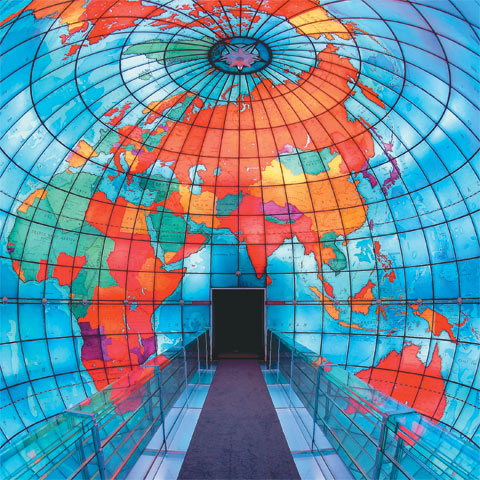
I wanted to write a bit about reversal or renewal of perspective as a source of awe. I've seen this in a number of different literary works, but one of the examples that sticks out most in my mind is the Mapparium scene in Jhumpa Lahiri's short story, "Sexy." The story follows the somewhat rocky relationship of an Indian woman named Miranda and her boyfriend, Dev and Lahiri uses the Mapparium scene as a way to explore perspective, suggesting that things (and at times, relationships) look different from the inside than they do from without. She paints the scene beautifully with a description of Miranda and Dev standing in a vast, globe-shaped room:
[H]e showed her his favorite place in the city, the Mapparium at the Christian Science center, where they stood inside a room made of glowing stained-glass panels, which was shaped like the inside of a globe but looked like the outside of one. In the middle of the room was a transparent bridge, so that it felt like standing in the center of the world. . . The ocean, as blue as a peacock's breast, appeared in two shades, depending on the depth of the water. He showed her the deepest spot on earth, seven miles deep, above the Mariana Islands. They peered over the bridge and saw the Antarctic archipelago at their feet, craned their necks and saw a giant metal star overhead. As Dev spoke, his voice bounced wildly off the glass, sometimes loud, sometimes soft, sometimes eluding Miranda's ear altogether.
The scene initially seems full of wonder from the sheer beauty of the description and the reversal of perspective, the characters looking at the world from inside rather than outside and seeing it almost as if with new eyes. Lahiri invites the reader to look at the world from a new perspective, and in creating such awe around a reversal of perspective, she helps the reader to anticipate the later ideological reversal with regard to Miranda's own views of her relationship and what it means to be "sexy."

In her Pichi Kuchi, +Jane Packard noted, "the digital world can enhance/expand/enable enjoyment of its antithesis, the natural world," showing how things like digital webcams allow us to experience the natural world in ways that would have been otherwise inaccessible. As does Lahiri's work, such digital resources invite us to see the world through new eyes and come to a richer and/or renewed perspective on life. Awe transforms the world so that we can be transformed with it.

Wednesday, February 19, 2014

Humility in Awe

When we experience humility in awe, we take a moment to think about things we cannot fully understand. The complexity of life and death can often humble us or bring us to stand on a threshold of things we do not fully comprehend. This idea is evident in James Joyce's Dubliners short story "The Dead."

Towards the end of the short story, Gabriel Conroy goes to a hotel with his wife hoping to share a romantic night together. He recalls an entire list of memories of their past that, for him, are some of the most important moments in their relationship. When Gretta (his wife) emotionally recounts the story of a former and deceased love interest, it's clear to Gabriel that his marriage hasn't been what he might have wished. In this sobering moment, he thinks about the dead and their ties to the living.

"Generous tears filled Gabriel's eyes... His soul had approached that region where dwell the vast hosts of the dead. He was conscious of, but could not apprehend, their wayward and flickering existence. His own identity was fading out into a grey impalpable world: the solid world itself, which these dead had one time reared and lived in, was dissolving and dwindling."

James Joyce calls this "the epiphany" - the moment when a character goes through something that becomes manifest, or there is a deep realization that changes their self or world view (awe too as been associated with a transcendent moment, a spiritual or secular realization moment). Where Gabriel had earlier made a division between the past of the dead and the present of the living, he now humbles himself and recognizes the lines between life and death are blurred. He sees himself "flickering" in the place where the living and dead meet. Michael Furey's memory lives on in Gretta's life. As Gabriel looks out of the window at the snow, Joyce continues to blur the lines between life and death.

Creative Commons 2.0 License
Dean Molyneaux / geograph.ie
Ballynahinch, City Republic of Ireland
"A few light taps upon the pane made him turn to the window. It had begun to snow again. He watched sleepily the flakes, silver and dark, falling obliquely against the lamplight... It was falling on every part of the dark central plain, on the treeless hills, falling softly upon the Bog of Allen and, farther westward, softly falling into the dark mutinous Shannon waves. It was falling, too, upon every part of the lonely churchyard on the hill where Michael Furey lay buried. It lay thickly drifted on the crooked crosses and headstones, on the spears of the little gate, on the barren thorns. His soul swooned slowly as he heard the snow falling faintly through the universe and faintly falling, like the descent of their last end, upon all the living and the dead."

Joyce uses this epiphany moment for the character as an epiphany moment (or a humbling-awe experience) for readers as well. Furey's grave is being covered in snow, just as the snow covers those living. Life and death is "covered in snow," but the difference is this: will we be remembered after death? We are humbled to think that the memory of someone dead could be stronger than the memory of someone alive.

This reminds me of +Jane Packard's research on awe vs pragmatism. She discusses how Wordsworth wrote his poetry in "awe-land." His experiences with awe are in literature and daffodils where pragmatism and death are the end of awe. Joyce blurs the lines of life and death, exploring the idea that death can provide more life because of living memories (like Furey's life in Gretta's memories), where our pragmatic lives can become mundane and perhaps meaningless (like Gabriel's life).

Tuesday, February 18, 2014

Response to Greg's Research

Hi Greg,

I’m not sure if you’ve decided yet whether to go with your initial research on disruptive awe/buzzfeed awe or pursue your curation post on biology and robots, so I’ll give a little feedback on each. (I suspect that nobody’s done a substantial post on yours yet because both ideas are already well researched and thorough, even in their preliminary form. Kind of like the paper that Fellows are scared to fellow….)

Buzzfeed Awe
A counterargument (to the extent that there’s an argument and that I understand it enough to counter it) to consider here: People know that the buzzfeed experience is cheap. A prerequisite or at least postrequisite to experiencing awe is recognizing it as such. I’ve browsed my fair share of buzzfeed, and my motives stemmed from boredom or search for novelty or whatever, but never from search for awe. And I don’t think that people come away from buzzfeed feeling real, stick-with-you, perspective-changing awe. Something’s going on with buzzfeed (or tumblr or pinterest or whatever), but it might not be awe.

Also, something that buzzfeed might do well is expose its consumer to the unknown, causing them to seek out something previously undiscovered to inspire real awe, or recollect a moment of real awe. Like, hypothetically, someone could read a list of reasons your mom is cool (my friend just posted one on this topic which I won’t repost because it’s not that clean now that I’ve actually read it) and that could cause the reader/viewer to connect or reconnect with their mom. Or a fallacious post about oceans could lead you to discover a counterpost and learn some legitimately awe-inspiring things about oceans, thanks to Google Scholar (https://blogs.discovermagazine.com/science-sushi/2013/08/23/16-things-buzzfeed-doesnt-know-about-the-ocean/).

In light of that, if you stick to this path, you might further explore or prove that awe is a fundamental human need. I’m still not sure I’m convinced of that. People can survive without awe.

Biology and Robots
This idea seemed to garner some more interest/ pass the social proof test with a higher score. But that might just be because of the youtube videos. Where do you come up with stuff like that? The Kara one freaked me out. 

This avenue would definitely be linked with Erin’s ideas on terror and awe. And probably linked somewhat to Paul’s videogameage, which we all know would be a terrible setback to your argument considering my ardent personal opposition to all things videogame. But the avatar exploration is awe-inspiring and digital and has solid ties to literature in a bunch of centuries—Frankenstein comes to mind as a prime example. This article might help.

Cheers, happy researching, etc.,
Jane