
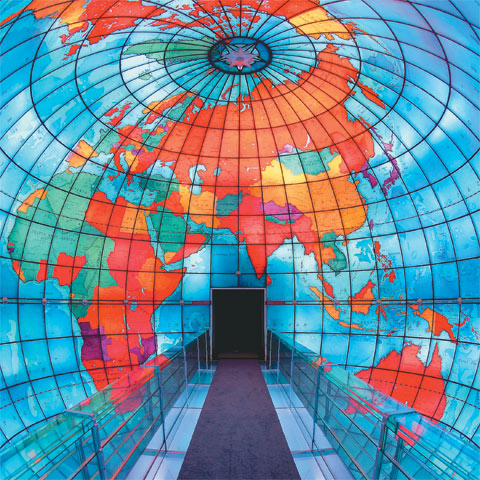
 I wanted to write a bit about reversal or renewal of perspective as a source of awe. I've seen this in a number of different literary works, but one of the examples that sticks out most in my mind is the Mapparium scene in Jhumpa Lahiri's short story, "Sexy." The story follows the somewhat rocky relationship of an Indian woman named Miranda and her boyfriend, Dev and Lahiri uses the Mapparium scene as a way to explore perspective, suggesting that things (and at times, relationships) look different from the inside than they do from without. She paints the scene beautifully with a description of Miranda and Dev standing in a vast, globe-shaped room:
[H]e showed her his favorite place in the city, the Mapparium at the Christian Science center, where they stood inside a room made of glowing stained-glass panels, which was shaped like the inside of a globe but looked like the outside of one. In the middle of the room was a transparent bridge, so that it felt like standing in the center of the world. . . The ocean, as blue as a peacock's breast, appeared in two shades, depending on the depth of the water. He showed her the deepest spot on earth, seven miles deep, above the Mariana Islands. They peered over the bridge and saw the Antarctic archipelago at their feet, craned their necks and saw a giant metal star overhead. As Dev spoke, his voice bounced wildly off the glass, sometimes loud, sometimes soft, sometimes eluding Miranda's ear altogether.The scene initially seems full of wonder from the sheer beauty of the description and the reversal of perspective, the characters looking at the world from inside rather than outside and seeing it almost as if with new eyes. Lahiri invites the reader to look at the world from a new perspective, and in creating such awe around a reversal of perspective, she helps the reader to anticipate the later ideological reversal with regard to Miranda's own views of her relationship and what it means to be "sexy."
In her Pichi Kuchi, +Jane Packard noted, "the digital world can enhance/expand/enable enjoyment of its antithesis, the natural world," showing how things like digital webcams allow us to experience the natural world in ways that would have been otherwise inaccessible. As does Lahiri's work, such digital resources invite us to see the world through new eyes and come to a richer and/or renewed perspective on life. Awe transforms the world so that we can be transformed with it.
