
Showing posts with label posted by Shelly. Show all posts
Showing posts with label posted by Shelly. Show all posts
Sunday, April 20, 2014

Tuesday, April 15, 2014
Discovering the Awe in Austen, the Journey
During the first few weeks of this course, I had no intentions of studying Jane Austen. I knew I'd have to pick a topic of study and I was sold on studying Wordsworth. In terms of awe, he is the first author to come to mind. So I read and reread his "Preface to Lyrical Ballads" trying to determine my angle in. This post describes a passage from Wordsworth and how Jane Austen became involved. I received a some helpful social proof with this idea on Google +. Amber and Cara both responded to my question: What draws readers to Jane Austen. Both of their remarks backed up my connection to Wordsworth; Austen wrote about the everyday; she took the mundane and transformed it.
I imagine my very first thesis would have gone something like this: The Romantic poets didn't like the silly and inauthentic gothic novels of the era. Austen parodies these novels so she didn't like them either. That makes Austen a Romantic which somehow somewhere connects to awe.
I imagine my very first thesis would have gone something like this: The Romantic poets didn't like the silly and inauthentic gothic novels of the era. Austen parodies these novels so she didn't like them either. That makes Austen a Romantic which somehow somewhere connects to awe.
Monday, April 14, 2014
Jane Austen and the Rhetoric of Awe: Final Paper
Here is the link to my finished paper! Google docs decided it didn't like my page number on the right side so ignore its annoying left placement . . .
Wednesday, March 26, 2014
Stop Motion Video .3: reaching for a personal angle
At this point, I have just about finished all of my drawings for the stop motion video. I haven't compiled them into a video however, so if you need a refresher on what they are, looks at this post. My next step is to actually make the video, and this is where it gets a little bit tricky.
I will be using quotes and text throughout to guide the viewer and make my point obvious, and my original idea was to include part of my own story with Austen into these text portions. However, Dr. Burton suggested I could do a voice over instead and talk through my video. I'm am really okay with either option and now just need to choose one.
Which option do you think would be more personal? Also, I want watching my video to be an "awesome" experience, so which of these methods would help bring that about? By next week, I should have a fully functional prototype of my video.
I will be using quotes and text throughout to guide the viewer and make my point obvious, and my original idea was to include part of my own story with Austen into these text portions. However, Dr. Burton suggested I could do a voice over instead and talk through my video. I'm am really okay with either option and now just need to choose one.
Which option do you think would be more personal? Also, I want watching my video to be an "awesome" experience, so which of these methods would help bring that about? By next week, I should have a fully functional prototype of my video.
Monday, March 24, 2014
Jane Austen: Scholarly Paper .3
This document is my working paper. Thanks to anyone who skims through it! I enabled commenting so feel free to comment if you have something to say.
Thursday, March 20, 2014
Awe in Austen: Annotated Bibliography
Thesis statement: While Jane Austen is little associated with the concepts of awe or wonder, despite her Romantic connections, I have found she uses three certain characteristics of awe in many of her novels: the Gothic sublime, surprise, and epiphany. These three concepts are linked to the theme of awe in many ways and by many theorists, however, one problem with Austen is deciphering where her use of awe is genuine and where it is satirical. This paper will explore Austen's use of these characteristics and whether her works merit acknowledgement as literature of awe.
(I'm really struggling with my thesis. It isn't concise and I don't think it would make much sense to anyone not in our class. Any suggestions?)
Bibliography:
This article discusses reading in Northanger Abbey. It talks about the Gothic literature Austen parodies and offers a thorough literary analysis of the text and the methods Austen uses for this parody. This article will be really helpful in my discussion on the Gothic in Northanger Abbey.
Bibliography:
- Benedict, Barbara. "Reading by the Book in Northanger Abbey." Persuasions On-Line. 20.1. (1999): N.p. Web. 19 Mar. 2014.
This article discusses reading in Northanger Abbey. It talks about the Gothic literature Austen parodies and offers a thorough literary analysis of the text and the methods Austen uses for this parody. This article will be really helpful in my discussion on the Gothic in Northanger Abbey.
- Bodenheimer, Rosemarie. "Looking at the Landscape in Jane Austen."Studies in English Literature, 1500-1900. 21.4. (1981): 605-623. Print.
Tuesday, March 18, 2014
Stop Motion Video: Prototype 1

Creative Project: Prototype 1
So I've decided to do a stop-motion video for my creative project. It is going to depict (metaphorically) Austen's work growing and being "monsterized" by society.
Here are three samples depicting different stages of this process (the scanner on my iPod is not great, so sorry for the poor quality). Now I need to just start drawing all of the in-between images!
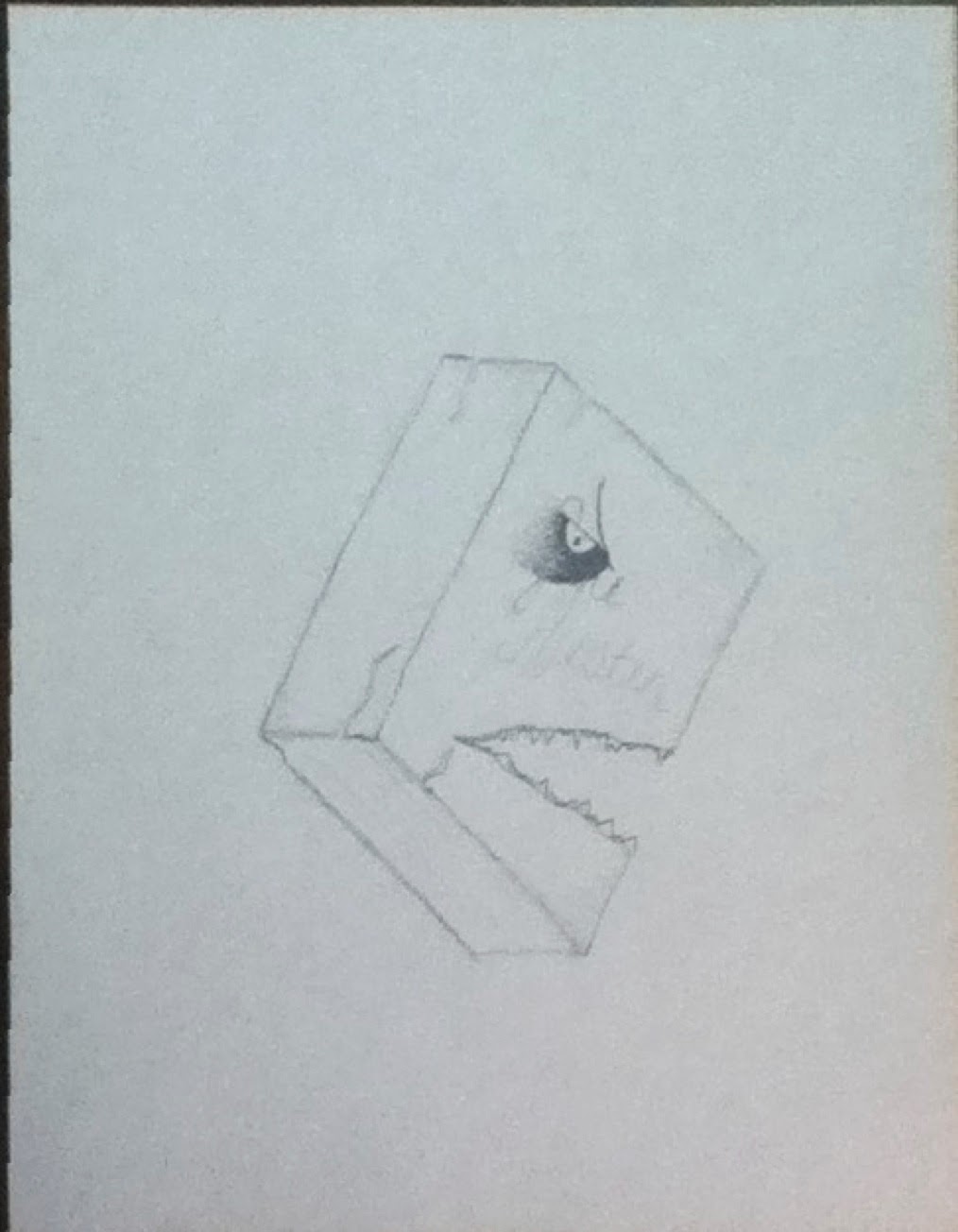 My video is going to show hands feeding this book different things, and this is what turns it into a monster. I also think I will use pictures of text as well to help the viewer understand what is happening. I need to start compiling pictures soon because I want to see which parts of the video need to be true stop motion and which parts I can show myself drawing, sped up. By combining these approaches I think I can cut down my work load a lot.
Any suggestions or criticisms? I hope this isn't too abstract or weird. Also, if you have drawing skills, what can I add or change to make this more effective?

Sunday, March 16, 2014
Shelly: Treatment
Paper Outline:
- Introduction
- Generally, Austen isn't linked to awe, even though she has Romantic tendencies. However, I think there are real ways that Austen uses the characteristics of awe in her novel (maybe satirically, maybe not).
- My first post about awe in Austen
- Gothic/Sublime
- Northanger Abbey
- "riposte to magic and mystery"
- Literary analysis of primary text: Northanger Abbey
- Catherine's obsession with gothic architecture, scary stories, dark mysteries
- This is first and foremost a satire of gothic awe. How does this change the awe?
- Cara's post on gothic awe
- Surprise
- "The Illusionist"
- Subtopic: Spectacle
- Austen as magician, compared to Wizard of Oz
- Unfamiliar, unexpected appearances. The common place becoming the wonderful (realist as a magician)
- Enchantment built into novel: achieved through combination of wonder and irony
- "Aesthetics and Ethics of Surprise"
- A genuine source of awe in Austen
- Epiphany--moments caused by nature
- "Looking at the Landscape in Jane Austen"
- Austen uses Romantic ideal of Nature to create moments of epiphany
- Pride and Prejudice
- Epiphany at Pemberley after touring the grounds
- Emma
- Berry-picking party, Emma lashes out, realizes her love for Knightley, admires his property and grounds
- Persuasion
- Epiphany: long walk with everyone at the beginning
- First meeting in Bath, rain forces Anne inside, Wentworth is able to find her. She fully realizes her feelings
- Sense and Sensibility
- Marianne almost dying outside in the rain leads to an epiphany
- Are these epiphany moments genuine or satirical? Both?
- Connections?
- Satire contradicts awe, yet Austen uses both
- Is her awe genuine or satirical?
- Discussion of current state of Austen's work? (I might not actually include this at all)
- What have her works become?
- Has awe been lost or created?
Prospective Venue:
I am pretty sure this journal is my number one choice for a publishing venue. My paper will most likely look like a traditional scholarly article, and I think I actually have a small chance of being published here. As far as I can tell, it is the only journal completely dedicated to Jane Austen scholarship, and from my own research for this paper, they seem willing to publish a wide variety of papers. There is also an online version of this journal. It doesn't say anywhere on their website, but I think the online version publishes a lot more than the print journal. So, if they don't take my submission for their print journal, I can most likely get it published online. They only take submission up to 3500 words and I am a little bit worried about fitting my paper into such a small amount of space.
What's Next:
I have a few solid sources referring to suprise, and one good source about nature. I really need to start digging into Austen's texts and finding quotes and passages which prove my points. And really I just need to start writing. I think I have a developed enough outline that drafting is totally possible. I've cut down the content of my paper a lot; now I am doing more of a literary analysis that focuses on the different ways Austen uses awe. I'm not sure if I will even try to pull in very much about popular culture and the distortion of Austen's works. That is the theme of my creative project, however, so do I need to address it in my paper? Is the narrower focus of my paper beneficial?
Tuesday, March 11, 2014
Creative Series
For my creative project I want to do a "series" of smaller components. I am thinking of writing a listicle, making an infographic, and creating some sort of photo essay or compilation of images.
Listicle: I want to focus my listicle on a sub-topic of my research. I am thinking something like "10 Great Moments of Irony in Austen" or "10 Instances of the Gothic in Austen." Is this weird or would it work?
Infographic: I think I will use my infographic to visually display the connection between Austen and awe. My connections are really complex and hard to simplify so an infographic would both force me to get a real handle on my argument and explain it in terms understandable by everyone else.
Image compilation: I am really struggling with this component because I have this AWESOME idea in my mind, just no way to make it happen the right way. The theme of this section will be the "monster" that Austen's body of work has become. It has been enlarged, distorted, destroyed, and twisted through all of its reworkings. I can also connect this to Frankenstein, a similar work that has been "monsterized" by society. In my mind I see an awesome series of drawings depicting this gradual morph into monster (i.e. a book getting bigger and nastier until it becomes an actual monster, complete with zombie heads and all that fun stuff). But I can't draw. Could I show the same sense in a photo essay? Any other ways to make this work? Or should I just start practicing my sketching . . .
Listicle: I want to focus my listicle on a sub-topic of my research. I am thinking something like "10 Great Moments of Irony in Austen" or "10 Instances of the Gothic in Austen." Is this weird or would it work?
Infographic: I think I will use my infographic to visually display the connection between Austen and awe. My connections are really complex and hard to simplify so an infographic would both force me to get a real handle on my argument and explain it in terms understandable by everyone else.
Image compilation: I am really struggling with this component because I have this AWESOME idea in my mind, just no way to make it happen the right way. The theme of this section will be the "monster" that Austen's body of work has become. It has been enlarged, distorted, destroyed, and twisted through all of its reworkings. I can also connect this to Frankenstein, a similar work that has been "monsterized" by society. In my mind I see an awesome series of drawings depicting this gradual morph into monster (i.e. a book getting bigger and nastier until it becomes an actual monster, complete with zombie heads and all that fun stuff). But I can't draw. Could I show the same sense in a photo essay? Any other ways to make this work? Or should I just start practicing my sketching . . .
Thursday, March 6, 2014
Where to Share: Options for My Jane Austen Project
JASNA Annual General Meeting (Jane Austen Society of North America)
I just Google searched Jane Austen Conference and this is what came up. This is pretty much the conference of all Jane Austen conferences. It takes place in a different city every year, and each conference is centered around a different theme. This year's theme is Mansfield Park (which my paper will have nothing to do with) but maybe an upcoming year could work for my paper.
Persuasions: The Jane Austen Journal
This is JASNA's journal for Austen scholarship. (And I think JASNA is pretty much where most Austen conversation happens). It is where I have found a lot of my own sources for this project. They publish a print and on-line version, so either option is available to me.
Journal of Popular Romance Studies
There are a lot of journals dedicated to Romantic studies (as I discovered from another Google search). This one seems focused on romance, not Romance, but their current issue is focused on 19th Century Britain (and they specifically mention the Jane Austen fan lit). Maybe they will have future issues suited to my paper as well.
BYU English Symposium
I have yet to present a paper at BYU's English Symposium. Though not specific to my topic, this would be a good experience for me, and it counts as presenting!
Intensities: The Journal of Cult Media
I found this blog-journal while looking for more "alternative" sources to share my project. They publish "refereed" essays but also have part of their site dedicated to open discussion on anything cult media. If my paper goes they way I expect it to, I should have a tie in to cult media studies.
AustenBlog
There are a lot of random Austen blogs out there. After searching through a lot of junk, I found this blog (which may also be junk) but it seemed more promising. This blog is dedicated to discussing all things Austen in popular culture. They don't accept any long or scholarly things but I bet I could submit parts of my brief "alternative" final project.
There are probably a ton of other places I could publish or present, but finding them are harder than I anticipated. I think my best bet is probably JASNA's journal; I have found some crazy things there so I feel like they are pretty open to accepting submissions.
I just Google searched Jane Austen Conference and this is what came up. This is pretty much the conference of all Jane Austen conferences. It takes place in a different city every year, and each conference is centered around a different theme. This year's theme is Mansfield Park (which my paper will have nothing to do with) but maybe an upcoming year could work for my paper.
Persuasions: The Jane Austen Journal
This is JASNA's journal for Austen scholarship. (And I think JASNA is pretty much where most Austen conversation happens). It is where I have found a lot of my own sources for this project. They publish a print and on-line version, so either option is available to me.
There are a lot of journals dedicated to Romantic studies (as I discovered from another Google search). This one seems focused on romance, not Romance, but their current issue is focused on 19th Century Britain (and they specifically mention the Jane Austen fan lit). Maybe they will have future issues suited to my paper as well.
BYU English Symposium
I have yet to present a paper at BYU's English Symposium. Though not specific to my topic, this would be a good experience for me, and it counts as presenting!
Intensities: The Journal of Cult Media
I found this blog-journal while looking for more "alternative" sources to share my project. They publish "refereed" essays but also have part of their site dedicated to open discussion on anything cult media. If my paper goes they way I expect it to, I should have a tie in to cult media studies.
AustenBlog
There are a lot of random Austen blogs out there. After searching through a lot of junk, I found this blog (which may also be junk) but it seemed more promising. This blog is dedicated to discussing all things Austen in popular culture. They don't accept any long or scholarly things but I bet I could submit parts of my brief "alternative" final project.
There are probably a ton of other places I could publish or present, but finding them are harder than I anticipated. I think my best bet is probably JASNA's journal; I have found some crazy things there so I feel like they are pretty open to accepting submissions.
Wednesday, February 26, 2014
The Death of the Agenda: Satire Turns to Awe
Roland Barthes' iconic essay "The Death of the Author" is a work read and known by all literature scholars. Though not in direct relation to awe or wonder, his ideas on language and authorship do influence the writing and studying of awe.
Barthes' stance on authorship and readership largely defines a huge portion of literary scholarship. Other theories like New Criticism as well as education-based reader-response theories are closely tied to many of Barthes' ideas. The premise of his essay is that authorship, a Western idea, is essentially nonexistent, and those who focus on authorship naturally limit a text and close its meaning.
He says, "Writing is the destruction of every voice, of every point of origin . . . . the voice loses its origin, the author enters into his own death." He refers to the shamans of older societies and their art of performance as an ancient and pure way of sharing writing, especially when compared to modernity's sole focus on the author. Barthes, however, goes beyond writing in his theory. In reference to language specifically, Barthes says:
Barthes' stance on authorship and readership largely defines a huge portion of literary scholarship. Other theories like New Criticism as well as education-based reader-response theories are closely tied to many of Barthes' ideas. The premise of his essay is that authorship, a Western idea, is essentially nonexistent, and those who focus on authorship naturally limit a text and close its meaning.
He says, "Writing is the destruction of every voice, of every point of origin . . . . the voice loses its origin, the author enters into his own death." He refers to the shamans of older societies and their art of performance as an ancient and pure way of sharing writing, especially when compared to modernity's sole focus on the author. Barthes, however, goes beyond writing in his theory. In reference to language specifically, Barthes says:
"It is language which speaks, not the author; to write is . . . to reach that point where only language acts, ‘performs’, and not ‘me’."
and:
and:
Tuesday, February 18, 2014
Jane: Awe in the Mundane
In Jane's pecha kucha presentation, she uses Wordsworth as an example of the contrast between awe and pragmatics. I thought this was really interesting, especially since I had just read these lines from Wordsworth's "Preface to the Lyrical Ballads":
"The principal object, then, which I proposed to myself in these poems was to choose incidents and situations from common life, and to relate or describe them, throughout, as far as was possible, in a selection of language really used by men; and, at the same time, to throw over them a certain colouring of imagination, whereby ordinary things should be presented to the mind in an unusual way . . . "
To me, this is Wordsworth's attempt at combining the pragmatics of the day-to-day and the unordinary awe-experiences of life in general. It's so easy to think the two are impossibly contradictory, but I think Wordsworth proves that one can really equal the other when the right perspective is taken.
He gives examples of specific poems and their purpose. Maybe these lists will give you ideas of text to read and draw from!
"This object I have endeavored in these short essays to attain by various means: by tracing the maternal passion through many of its more subtle windings, as in the poem of the Idiot Boy and the Mad Mother; by accompanying the last struggles of a human being, at the approach of death, cleaving in solitude to life and society, as in the poem of the Forsaken Indian; by shewing, as in the stanzas entitles We Are Seven, the perplexity and obscurity which in childhood attend our notion of death, or rather our utter inability to admit that notion . . . "
(This next list offers poems with a different perspective)
"It has also been part of my general purpose to attempt to sketch characters under the influence of less impassioned feelings,"--he gives these examples: Two April Mornings, The Fountain, The Old Man Travelling, The Two Thieves
Last, one of Wordsworth's final poems, Extempore Effusion upon the Death of James Hogg, is said to mirror his style in the Lyrical Ballads. This could be a really interesting poem to look at with your perspective! Did pragmatics or awe win out for Wordsworth in the end?
"The principal object, then, which I proposed to myself in these poems was to choose incidents and situations from common life, and to relate or describe them, throughout, as far as was possible, in a selection of language really used by men; and, at the same time, to throw over them a certain colouring of imagination, whereby ordinary things should be presented to the mind in an unusual way . . . "
To me, this is Wordsworth's attempt at combining the pragmatics of the day-to-day and the unordinary awe-experiences of life in general. It's so easy to think the two are impossibly contradictory, but I think Wordsworth proves that one can really equal the other when the right perspective is taken.
He gives examples of specific poems and their purpose. Maybe these lists will give you ideas of text to read and draw from!
"This object I have endeavored in these short essays to attain by various means: by tracing the maternal passion through many of its more subtle windings, as in the poem of the Idiot Boy and the Mad Mother; by accompanying the last struggles of a human being, at the approach of death, cleaving in solitude to life and society, as in the poem of the Forsaken Indian; by shewing, as in the stanzas entitles We Are Seven, the perplexity and obscurity which in childhood attend our notion of death, or rather our utter inability to admit that notion . . . "
(This next list offers poems with a different perspective)
"It has also been part of my general purpose to attempt to sketch characters under the influence of less impassioned feelings,"--he gives these examples: Two April Mornings, The Fountain, The Old Man Travelling, The Two Thieves
Last, one of Wordsworth's final poems, Extempore Effusion upon the Death of James Hogg, is said to mirror his style in the Lyrical Ballads. This could be a really interesting poem to look at with your perspective! Did pragmatics or awe win out for Wordsworth in the end?
Thursday, February 13, 2014
Collaborative Blogging
Collaborative Blogging: For my curation, I decided to look at some well known group blogs. Pop culture's tendency to fixate on certain things is an important aspect of my research this semester and I feel that the blogs I've chosen to spot light showcase either awe or spectacle in some way. Collaborative blogging is quickly growing in popularity and has some produced some really awe-some projects.
The Anti-Austen: To begin, a blog that directly relates to my area of study, and one most BYU females are aware of. The Anti-Austen is a group blog where anonymous females post about their experiences in the Provo dating scene along side their desire to meet the modern Mr. Darcys and Mr. Knightleys. This blog has developed a cult-like following among YSA females. byudates.blogspot.com

Brevity: This blog serves as a kind of "idea forum" for Brevity's magazine, a magazine which publishes short essays from up-and-coming authors. On this blog, people are invited to subscribe and post, almost as a precursor to publishing in the actual magazine. This blog serves as a community for those interested in creative non-fiction writing. brevity.wordpress.com

Six Sisters' Stuff: This blog is a hugely popular "mormon mommy blog" run by a family of six sisters. They post recipes mostly, and have become one of the most popular food blogs out there. Proof that blogs designed for personal and familial purposes can become pop culture phenomenons. www.sixsistersstuff.com
 Noisy Pilgrims: This blog is a photo blog designed around India. Six collaborators submit photos from their experiences in India. The photography itself is enough to inspire awe! noisypilgrims.com
 Peanut Butter on the Keyboard: This group blog features six moms/fiction writers. They collaborate together to discuss motherhood, writing, and other various topics. This is kind of spectacular to me because it shows that there is space online for anyone and everyone to connect! peanutbutteronthekeyboard.com

Overexposed + Underdeveloped: 10 friends connecting through photography. A really cool alternative to the classic "mormon mommy" blog, if you're not really into that kind of thing. Beautiful pictures and fresh ideas. overexposedandunderdeveloped.com

Spilled Milk: Another mommy blog (see the trend?), though this is a photography blog run by 14 mothers from around the world. Is it weird or cool that we are naturally drawn to following peoples' lives like this? I mean, it sounds incredibly boring, to follow a blog that just posts someone's personal photos, but follow we do. spilledmilkblog.wordpress.com

Just Me and My Dad: This blog features a weekly picture from Claire and her dad. It's simple, it's personal, and it's fascinating. I couldn't stop looking because I loved the stories in the photos, and the amazing connections happening digitally. If the ability to connect continually with a family member through photography and the internet isn't awe-inspiring, what is? (If nothing else, read the about page, it is wonderful) justmeandmydad.wordpress.com
Maybe collaborative blogs aren't awe-inspiring in all aspects, but blogs in general are such an exciting development in the world of text and writing. I think collaborative blogs add another dimension of awe because they represent creation within a community, and the possibility of connections that have never been possible before. Do you have any favorite blogs that you follow? Do you prefer collaborative or individual blogs?

The Anti-Austen: To begin, a blog that directly relates to my area of study, and one most BYU females are aware of. The Anti-Austen is a group blog where anonymous females post about their experiences in the Provo dating scene along side their desire to meet the modern Mr. Darcys and Mr. Knightleys. This blog has developed a cult-like following among YSA females. byudates.blogspot.com
Brevity: This blog serves as a kind of "idea forum" for Brevity's magazine, a magazine which publishes short essays from up-and-coming authors. On this blog, people are invited to subscribe and post, almost as a precursor to publishing in the actual magazine. This blog serves as a community for those interested in creative non-fiction writing. brevity.wordpress.com
Six Sisters' Stuff: This blog is a hugely popular "mormon mommy blog" run by a family of six sisters. They post recipes mostly, and have become one of the most popular food blogs out there. Proof that blogs designed for personal and familial purposes can become pop culture phenomenons. www.sixsistersstuff.com
Overexposed + Underdeveloped: 10 friends connecting through photography. A really cool alternative to the classic "mormon mommy" blog, if you're not really into that kind of thing. Beautiful pictures and fresh ideas. overexposedandunderdeveloped.com
Spilled Milk: Another mommy blog (see the trend?), though this is a photography blog run by 14 mothers from around the world. Is it weird or cool that we are naturally drawn to following peoples' lives like this? I mean, it sounds incredibly boring, to follow a blog that just posts someone's personal photos, but follow we do. spilledmilkblog.wordpress.com
Just Me and My Dad: This blog features a weekly picture from Claire and her dad. It's simple, it's personal, and it's fascinating. I couldn't stop looking because I loved the stories in the photos, and the amazing connections happening digitally. If the ability to connect continually with a family member through photography and the internet isn't awe-inspiring, what is? (If nothing else, read the about page, it is wonderful) justmeandmydad.wordpress.com
Maybe collaborative blogs aren't awe-inspiring in all aspects, but blogs in general are such an exciting development in the world of text and writing. I think collaborative blogs add another dimension of awe because they represent creation within a community, and the possibility of connections that have never been possible before. Do you have any favorite blogs that you follow? Do you prefer collaborative or individual blogs?
Thursday, January 30, 2014
The Awe in Austen
I posted a question on Google+ asking what kind of awe Jane Austen had inspired in those who've read her. Here are two responses:
"She wrote depictions of everyday, ordinary activities and experiences, yet still became this phenomenon celebrated today. We've talked about the mundane, how it gets harder to find awe in the routine. Jane Austen created awe from the mundane. So it is possible to find awe in anything I suppose, mundane or grand, if you are consciously or subconsciously looking for it." -Amber
"I was always in awe of her ability to take the mundane and ordinary social interactions of her day and magnify them into these iconic stories." -Cara
This semester, I want to research Austen's literary texts as well as the cultural phenomenon surrounding her works. I had no intention to write about Austen for this class, but I experienced my own moment of awe in the form of an epiphany while reading from Wordsworth's "Preface to Lyrical Ballads." It was while reading the following two passages when I realized my love for Austen is something I could study and actually write about:
"I was always in awe of her ability to take the mundane and ordinary social interactions of her day and magnify them into these iconic stories." -Cara
This semester, I want to research Austen's literary texts as well as the cultural phenomenon surrounding her works. I had no intention to write about Austen for this class, but I experienced my own moment of awe in the form of an epiphany while reading from Wordsworth's "Preface to Lyrical Ballads." It was while reading the following two passages when I realized my love for Austen is something I could study and actually write about:
Tuesday, January 28, 2014
so i read it again
*Made possible by a little inspiration from Juliet
One summer evening (led by her) I foundA little boat tied to a willow tree
Within a rocky cave, its usual home.
the following lines of verse are the only ones i have
remembered and loved for any long period of time
(Isn't it beautiful how summer evenings lead all of us?
They make it impossible to resist the warm air and late-setting sun)
Straight I unloosed her chain, and stepping inPushed from the shore. It was an act of stealth
And troubled pleasure, nor without the voice
Of mountain-echoes did my boat move on;
it was a normal day in English class:
"here is a poem--read it, talk about it"
(Stealth and troubled pleasure--the two
best descriptions for an act of thievery.
And the idea of mountain-echo voices is enchanting)
Leaving behind her still, on either side,And the idea of mountain-echo voices is enchanting)
Small circles glittering idly in the moon,
Until they melted all into one track
Of sparkling light.
i read it once and thought: hmm pretty, what does it mean?
(These lines are beautiful, circles
of light on a moonlit lake. Melting. Yes, I guess
now that I think about it, melting is exactly what they do)
But now, like one who rows,
Proud of his skill, to reach a chosen point
With an unswerving line, I fixed my view
Upon the summit of a craggy ridge,
The horizon's utmost boundary; far above
Was nothing but the stars and the grey sky.
Proud of his skill, to reach a chosen point
With an unswerving line, I fixed my view
Upon the summit of a craggy ridge,
The horizon's utmost boundary; far above
Was nothing but the stars and the grey sky.
i guess my classmates thought the same,
given their blank stares and "umms"
so i read it again
(the "but" worries me, something has changed.
He was looking back at the water, now his
attention is on the horizon, the sky empty with stars.
attention is on the horizon, the sky empty with stars.
Nothing wrong with that . . . if it weren't for that pesky "but")
She was an elfin pinnace; lustilyI dipped my oars into the silent lake,
And, as I rose upon the stroke, my boat
Went heaving through the water like a swan;
it was obvious i was missing the point
this poem meant something, and
i was just confused. what's the big deal, i naively wondered
(The mood has changed. Lustily? Heaving?
What is this rower after?I'm starting to think the boat isn't
the only thing being stolen this summer evening. There is something
else, something bigger on this rower's agenda)
When, from behind that craggy steep till thenThe horizon's bound, a huge peak, black and huge,
As if with voluntary power instinct,
Upreared its head. I struck and struck again,
And growing still in stature the grim shape
Towered up between me and the stars, and still,
For so it seemed, with purpose of its own
And measured motion like a living thing,
Strode after me.
right here is where I lost meaning
a huge peak uprearing its head?
but mountains don't just come from nowhere and
chase down a lowly (though albeit greedy) man!
perhaps the metaphor was too much for me
(The climax, and one of the most powerful
descriptions of nature I've ever read. The unsuspecting man
delves too far into nature, and a new horizon is revealed.
Only, this peak towers and blocks the stars,
Nature in its purest form removes the comfort we seek.
Nature in its purest form removes the comfort we seek.
She rears her huge head when someone tries
to steal a moment from her)
to steal a moment from her)
With trembling oars I turned,
And through the silent water stole my way
Back to the covert of the willow tree;
There in her mooring-place I left my bark,--
And through the meadows homeward went, in grave
And serious mood; but after I had seen
That spectacle, for many days, my brain
Worked with a dim and undetermined sense
Of unknown modes of being; o'er my thoughts
There hung a darkness, call it solitude
Or blank desertion. No familiar shapes
Remained, no pleasant images of trees,
Of sea or sky, no colours of green fields;
But huge and mighty forms, that do not live
Like living men, moved slowly through the mind
By day, and were a trouble to my dreams.
And through the silent water stole my way
Back to the covert of the willow tree;
There in her mooring-place I left my bark,--
And through the meadows homeward went, in grave
And serious mood; but after I had seen
That spectacle, for many days, my brain
Worked with a dim and undetermined sense
Of unknown modes of being; o'er my thoughts
There hung a darkness, call it solitude
Or blank desertion. No familiar shapes
Remained, no pleasant images of trees,
Of sea or sky, no colours of green fields;
But huge and mighty forms, that do not live
Like living men, moved slowly through the mind
By day, and were a trouble to my dreams.
okay, i thought. i think i get this
a man steals into nature, alone
and with every purpose of conquering,
overcoming, but then some big scary thing that I still don't understand happens, leaving
him unsure, and suddenly aware
there's more to Nature than he thought
and finally my teacher said, "okay class, let's talk about a new idea: the sublime"
a man steals into nature, alone
and with every purpose of conquering,
overcoming, but then some big scary thing that I still don't understand happens, leaving
him unsure, and suddenly aware
there's more to Nature than he thought
and finally my teacher said, "okay class, let's talk about a new idea: the sublime"
(Edmund Burke said, "the mind is so entirely filled
with its object, that it cannot entertain any other,
nor by consequence reason on that object which employs it."
And now the words that have never really left my mind since the first time I read this:
And now the words that have never really left my mind since the first time I read this:
"huge and mighty forms, that do not live like living men, moved slowly through the mind"
I get this, I know this. I experience this every time I breach that place of awe and transcendence. How scary it is to feel so powerless in the face of a bigger dimension, and yet, it's these experiences I remember with wonder. Sometimes Wordsworth's huge peak rears its head at me, and I am both astonished and terrified--going back to real life after that feels so unnatural. So maybe that's why this poem sticks with me; these encounters with the sublime are a part of the human experience. They are as rare as they are transformative. And each time I read Wordsworth's words, those "huge and mighty forms move slowly through" my mind once more.
Sunday, January 26, 2014
My Listicle of Awe
Listicle: a listicle is a short-form of writing that uses a list as its thematic structure
- Persuasion & Emma, Jane Austen
- The maturity of Persuasion astounds me, and Anne is perfect. Emma is so different from her others and really changed me in many ways. The two together inspire awe.
- Jane Eyre, Charlotte Bronte
- This is that book for me, the one I love so much that no one can ruin it. I love this book in a way I don't even understand.
- A Thousand Splendid Suns & The Kite Runner, Khaled Hosseini
- I was only going to put A Thousand Splendid Suns until I realized that the two books together are what inspired awe in me. Such beautiful stories and language.
- Brave New World, Aldous Huxley
- I just remember reading the end and having epiphany after epiphany as Huxley ties all of his themes together; I would reread certain passages dozens of times while I tried to wrap my head around everything.
- "The Stolen Boat" episode in The Prelude, William Wordsworth
- Beautiful language, beautiful imagery, and the perfect experience with the sublime in nature.
- Steinbeck, anything really
- Stories that stick with you even when you don't want them to.
- Hamlet or King Lear, Shakespeare
- Hamlet was my first authentic experience with Shakespeare and when I realized for myself how brilliant he was. Lear was this same experience transcended.
- The King Follett Discourse, Joseph Smith
- A mind-blowing source of information and revelation.
- Invictus, William Ernest Henley
- So much power in so few lines. Also, the movie Invictus about Nelson Mandela and rugby is one of the only films that has ever inspired wonder/awe in me.
- The Book Thief, Markus Zusak
- The most powerful YA book I've ever read. The imagery and craft of the language is astounding.
Thursday, January 23, 2014
Inquiry


"Inquiry is wonder" said a fellow classmate during an inspired discussion about teaching writing. Naturally, at the word wonder I dove into my backpack and grabbed my wonder journal, scrawling this quote on the first blank page. When I had to go back and write my entry, I pondered about what this statement even means. I guess that wondering about something is very similar to inquiring about something, though how are wondering and wonder itself related?
Some ideas I have come to:
- Inquire means to "make a formal investigation," which is decidedly different than simply asking.
- Inquire comes from a Latin word meaning "seek," again different than asking.
- Inquiry implies action beyond asking questions; it implies looking for an answer, researching, investigating.
In the context of teaching writing, inquiry leads to more engagement and a higher experience. Is this "higher experience" something that can translate to other contexts? Can inquiry about the unknown, the overwhelming, the eternal, the sublime lead to an awe-inspiring experience? I think yes, though I think inquiry is just one of many pathways to an encounter with awe and wonder. What about you guys? Have you thought how "wondering things" leads to wonder itself?
Friday, January 17, 2014
A Bigger Perspective on the Universe
My first post from my wonder journal talks about how reading 2001: A Space Odyssey gave me some new, awe-inspiring questions about the universe. Growing up, I was never really into outer-space or astronauts so I never spent much time pondering or experiencing awe about the universe around me. As I've grown, I've learned to love looking at the stars, and finding awesome telescope images like these:
(There are a lot more like this at the link). The planets, however, have never been a source of awe for me. This all changed when reading 2001: A Space Odyssey.
 This passage from chapter 20 "The World of the Gods" gave a frightening and awe-inspiring description of Jupiter. While this is a fictional image, I was struck by the idea that Jupiter is made of something. It is made of a lot of things and looks like a lot of things that we are unaware of because we can't technologically see everything there. I then began wondering the purpose of Jupiter's creation. It has always been my belief that God created the universe, and finally the realization that God created Jupiter (and Mars, and Saturn, etc) for a purpose hit me.
Moses 1:39 reads, "For behold, this is my work and my glory--to bring to pass the immortality and eternal life of man." God has a purpose, and most likely all of His creations pertain to this purpose. The awe-inspiring questions this knowledge has given me are: what is the eternal purpose of unihabited planets? Why did God create Jupiter? What knowledge are we missing about creation and planets, and even the "empty" space that fills so much of the universe? This distance and space must serve a purpose, what is that purpose? How much more knowledge am I not able to understand/access in this life?
 |
| http://local.msn.com/nasa-nebulae |
(There are a lot more like this at the link). The planets, however, have never been a source of awe for me. This all changed when reading 2001: A Space Odyssey.
Moses 1:39 reads, "For behold, this is my work and my glory--to bring to pass the immortality and eternal life of man." God has a purpose, and most likely all of His creations pertain to this purpose. The awe-inspiring questions this knowledge has given me are: what is the eternal purpose of unihabited planets? Why did God create Jupiter? What knowledge are we missing about creation and planets, and even the "empty" space that fills so much of the universe? This distance and space must serve a purpose, what is that purpose? How much more knowledge am I not able to understand/access in this life?
Subscribe to:
Posts (Atom)