Looking toward my wunderkammer and coming out of my tutorial interview with Dr. Burton, I've come up with my own preliminary list of what aspects of videogames most often inspire awe. I'm following in the footsteps of +Amber Z here with her great similar post on the elements of awe.
1. Technology
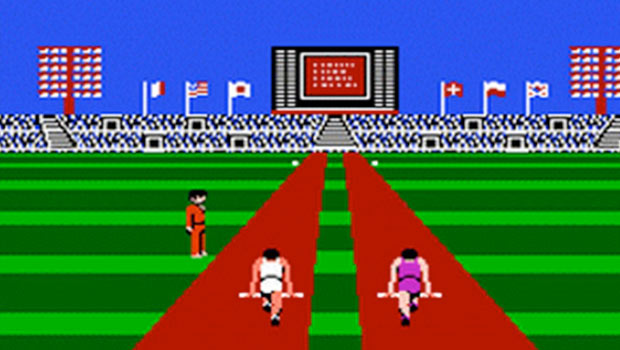
The most obvious source of awe from videogames is the advanced technology. Believe it or not, "realistic graphics!" has been a marketing buzz phrase in videogames since at least the 80s, when games looked like this:
In every phase of videogames' development and (short) history, they've been specifically designed to wow people with what new "magic" computers can do. In fact, the impetus for the creation of what many call the first videogame, Spacewar!, was an attempt to find a way to get people to appreciate the giant computer systems in the basement of MIT. People didn't really understand what computer were for, but videogames helped them realize they were at least useful for something.
We can have awe looking at a painting, reading a book, listening to music, watching a movie, etc. Is it awe because of the completed project or image itself, or is it a combination of elements that creates an entire experience of awe?
I've got a basic idea of this question (perhaps a rough thesis for my final paper) or what the combination of elements are that function in creating awe. Here's a rough draft of the three elements of creating awe I wrote in my writing journal last Friday:
1. The Idea
Wikipedia Images Creative Commons
This is the starting point before anything can be created. After +Paul Bills presentation on the video games, I had to tell my roommate about the game Brothers. I commented on his blog post about how just the idea of the mechanics and lessons taught in Brothers was enough to awe my roommate when I told her about it. She didn't witness what happened, but it captured awe nonetheless. Paul replied saying it was like "the moment in 2001 when the ape-man first realizes he can swing the bone as a club." The idea sparks awe. It ignites the potential to create an awe inspiring work.
2. The Senses
Infinite Dreams by artist Rhads
To experience awe we have to at least see it, smell it, taste it, touch it, hear it, or think it. A picture is visually-intensive. I posted a link to some incredible pictures on Google+ here. Paul, +Andrew Perazzo, and +Erin McMullin seemed to find a sense of awe in them too. Erin said "he takes the simple and mundane and makes it great." I've discussed the hearing sense in some more detail here, where I had a lot of input on what songs inspired awe from Paul, Andrew, and +Jane Packard. So it's clear elements of awe can individually create awe. But what about in a movie that combines visual, script, and sound?
3. Combination
I'm still developing this idea so bear with me. I think many people (especially English majors and book-lovers) too often discredit movies by saying "it isn't as good as the book." Movies are not intended to "be the book." It's a movie. It is meant to recreate awe from a book with a new perspective for the book-reader, and to express awe to those unexposed to said book. I've done some research on how movie makers are recreating awe. Check out here and here (embedded video), and comment with your ideas!
Talking about the movie Apollo 13, special effects supervisor Rob Legato took people's memories of the actual spaceship's launch to emulate it in the movie. He combined the awe felt by different people to create his own scene. This new scene, scientifically inaccurate to what an actual launch would entail, created a new sense of awe because of the combined memories of people. The nostalgia was there; the graphics were there; the cinematography was there. These efforts recreated awe in a new light.
I think if you take single elements you can have feelings of awe. If combined, though, imagine the potential for these elements to create or recreate something even bigger. What do you think?
The title above is the same title I gave an entry in my wonder journal this week. After going back to try and find literature that inspired awe in me in my life for another class assignment, I realized that some things I reacted to quite passionately before now just don't even move me an inch. That got me reflecting on my own life path and I realized with a jump of awe and wonder that a year ago at the time of this writing, I had not even yet considered the idea of videogames as art.
That means that within the space of just 12 months, I went from being unsure about what I wanted to do exactly with my life but leaning toward literature professor or maybe ditching English altogether for sociology, to planning my entire career path around a subject I was almost completely unversed in at the time.
The decision alone might be somewhat impressive, but what's really blown me away is how quickly I was able to dive into that decision. Not only did I say I would do something totally different than I had ever planned before, I've written over 20 in-depth blog posts on videogames, presented at a professional conference on the subject, been featured in one of the leading blogs of the field, and published on an online journal. I don't say these things to brag about my accomplishments, but to wonder at how quickly I turned so completely around and dove so deep into this field.
Considering how quickly it all happened, I almost panicked for a second. I've now applied to two different graduate programs to carry on this path I've started down, and considering how quickly I changed from one thing to another in just a year made me wonder if I'd totally change my mind again in another year's time. For a second, I wondered if I even liked videogames that much, to dedicate potentially my entire professional life to them. It was pretty easy to reassure myself that I did, but it was still a wondrous thought.
Where will I be a year from now? If the past year has been any indication, I really have absolutely no idea.
Okay, my class presentation showing off The Last of Us, Bioshock Infinite, and Brothers: A Tale of Two Sons just finished. I'm counting the presentation itself and comments from the rest of the class as enough social proof to write a blog post about these moments that have inspired awe in me and want to take this opportunity to follow-up and perhaps better explain some things that weren't totally clear in the presentation itself.
To be honest, I have no idea how much awe was actually felt by members of the class as I showed them these three videogame sequences. I noticed +Carly Brown say, "That's so cool," when we solved the swimming problem in Brothers, and +Andrew Perazzo enthusiastically commented on how good the graphics looked in Bioshock. I also heard a few murmurs generally as the Salt Lake Temple first came into view in the sequence from The Last of Us. I feel like the first presentation could have been a lot more powerful if I hadn't screwed up the saved game like I did, and I sincerely apologize to everyone for the weird starting foot that put us on for the whole presentation. I'd like to take a moment to better examine each sequence and why it specifically inspires awe.
The Last of Us
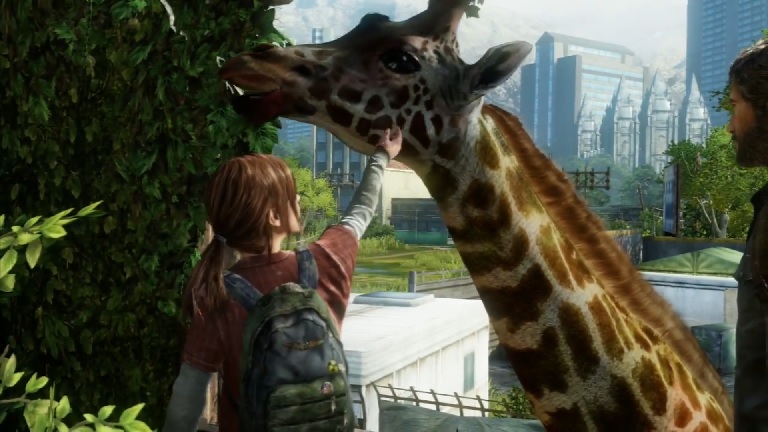
After screwing up the game itself and resulting to YouTube, I stumbled through showing the instantly iconic giraffe sequence from The Last of Us. I mentioned in class the masterful subtly of this sequence as well the poignant symbolism of the giraffe walking out of the shot after Ellie takes full responsibility and the (literal) lead in going forward to find a cure and we realize Ellie childhood innocence is now totally gone and she's become an adult before her time (she's only 14). I also emphasized how breathtaking the sequence is against the backdrop of hours and hours of violence that come before it.